
Ch.16 - Acids and Bases
Tro - Chemistry: A Molecular Approach 4th Edition
Tro4th EditionChemistry: A Molecular ApproachISBN: 9780134112831Non è quello che usi tu?Cambia libro di testo
Capitolo 16, Problema 144

What is the concentration of ammonia in a solution prepared by dissolving 0.10 mol of acetic acid and 0.10 mol of ammonium chloride in enough water to make 1.0 L of solution?

Guida verificata passo dopo passo
1
Identify the relevant chemical reaction: Ammonium chloride (NH4Cl) dissociates in water to form ammonium ions (NH4+) and chloride ions (Cl-).
Recognize that ammonium ions (NH4+) can react with water to form ammonia (NH3) and hydronium ions (H3O+). This is an example of an acid-base equilibrium.
Write the equilibrium expression for the reaction: NH4+ + H2O ⇌ NH3 + H3O+. The equilibrium constant expression (Ka) for this reaction is Ka = [NH3][H3O+]/[NH4+].
Use the initial concentrations: Initially, [NH4+] = 0.10 M and [NH3] = 0 M. Assume x is the change in concentration at equilibrium, so [NH3] = x and [NH4+] = 0.10 - x.
Substitute the equilibrium concentrations into the Ka expression and solve for x, which represents the concentration of ammonia (NH3) at equilibrium.

Concetti chiave

Ecco i concetti essenziali che devi comprendere per rispondere correttamente alla domanda.

Concentration

Concentration refers to the amount of a substance (solute) present in a given volume of solution. It is commonly expressed in moles per liter (Molarity, M), which is calculated by dividing the number of moles of solute by the volume of the solution in liters. Understanding concentration is essential for determining how much of a solute is available for reactions or interactions in a solution.
Video consigliato:
Percorso guidato
07:35
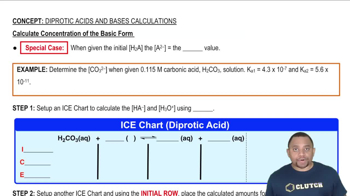
Calculate Concentration of the Basic Form

Acetic Acid and Ammonium Chloride in Solution

Acetic acid (CH₃COOH) is a weak acid that partially dissociates in solution, while ammonium chloride (NH₄Cl) is a salt that dissociates completely into ammonium ions (NH₄⁺) and chloride ions (Cl⁻). The presence of these two compounds in the solution affects the pH and the equilibrium of the system, which is important for understanding the behavior of ammonia (NH₃) in the solution.
Video consigliato:
Percorso guidato
00:48
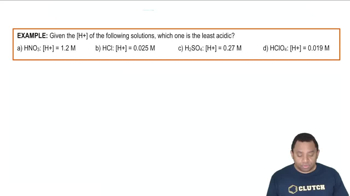
Least Acidic Solution Example

Equilibrium and Ammonia Formation

In the context of this solution, ammonia can form from the dissociation of ammonium ions in equilibrium with acetic acid. The equilibrium constant (Ka) for acetic acid and the relationship between the concentrations of the species involved are crucial for calculating the concentration of ammonia. This concept is vital for understanding how the weak acid and its conjugate base interact in the solution.
Video consigliato:
Percorso guidato
02:34
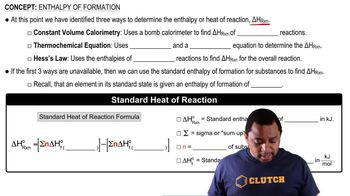
Enthalpy of Formation