
Ch.16 - Acids and Bases
Tro - Chemistry: A Molecular Approach 4th Edition
Tro4th EditionChemistry: A Molecular ApproachISBN: 9780134112831Non è quello che usi tu?Cambia libro di testo
Capitolo 16, Problema 145

Lactic acid is a weak acid found in milk. Its calcium salt is a source of calcium for growing animals. A saturated solution of this salt, which we can represent as Ca(Lact)2, has a [Ca2+] = 0.26 M and a pH = 8.78. Assuming the salt is completely dissociated, calculate the Ka of lactic acid.

Guida verificata passo dopo passo
1
Identify the dissociation of the salt: Ca(Lact)_2 \(\rightarrow\) Ca^{2+} + 2 Lact^{-}.
Recognize that the pH of the solution is 8.78, which indicates a basic solution, and calculate the pOH: \(\text{pOH}\) = 14 - \(\text{pH}\).
Calculate the hydroxide ion concentration [OH^-] using the formula: [OH^-] = 10^{-\(\text{pOH}\)}.
Use the relationship between the weak acid and its conjugate base to set up the expression for the equilibrium constant (K_a) of lactic acid: K_w = K_a \(\times\) K_b, where K_w is the ion-product constant of water.
Determine the K_b for the lactate ion using the concentration of OH^- and the initial concentration of Lact^{-}, then solve for K_a using the relationship K_a = \(\frac{K_w}{K_b}\).

Risposta video verificata per un problema simile:

Questa soluzione video è stata consigliata dai nostri tutor come utile per risolvere questo problema.
Durata del video:
4m

Concetti chiave

Ecco i concetti essenziali che devi comprendere per rispondere correttamente alla domanda.

Weak Acids and Their Dissociation

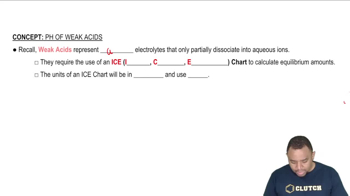
Weak acids, like lactic acid, do not completely dissociate in solution. Instead, they establish an equilibrium between the undissociated acid and its ions. The degree of dissociation is characterized by the acid dissociation constant (Ka), which quantifies the strength of the acid. Understanding this concept is crucial for calculating Ka from concentration and pH.
Video consigliato:
Percorso guidato
00:44
ICE Charts of Weak Acids

pH and Its Relationship to Hydrogen Ion Concentration

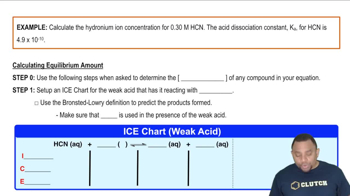
pH is a measure of the hydrogen ion concentration in a solution, defined as pH = -log[H+]. A higher pH indicates a lower concentration of hydrogen ions, which is typical for weak acids in solution. In this case, the pH of 8.78 suggests a relatively low concentration of H+ ions, which is essential for determining the equilibrium concentrations needed to calculate Ka.
Video consigliato:
Percorso guidato
06:25
Hydronium Ion Concentration Example

Equilibrium Expressions and Ka Calculation

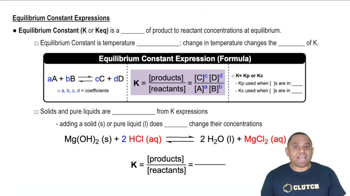
The acid dissociation constant (Ka) is calculated using the equilibrium concentrations of the acid and its ions. For lactic acid, the dissociation can be represented as HA ⇌ H+ + A-. The Ka expression is given by Ka = [H+][A-]/[HA]. By using the known concentrations from the saturated solution and the pH, one can rearrange this expression to solve for Ka, providing insight into the acid's strength.
Video consigliato:
Percorso guidato
03:20
Equilibrium Constant Expressions