Ch.16 - Acids and Bases
Tro - Chemistry: A Molecular Approach 4th Edition
Tro4th EditionChemistry: A Molecular ApproachISBN: 9780134112831Non è quello che usi tu?Cambia libro di testo
Capitolo 16, Problema 117

Based on their molecular structure, choose the stronger acid from each pair of binary acids, and explain your choice: a. HF and HCl b. H2O and HF c. H2Se and H2S.

Guida verificata passo dopo passo
1
Identify the periodic trend for acidity in binary acids: Acidity generally increases down a group in the periodic table due to the increase in atomic size, which weakens the H-X bond, making it easier to donate a proton.
For pair (a) HF and HCl: Compare the position of fluorine and chlorine in the periodic table. Chlorine is below fluorine, indicating that HCl is a stronger acid than HF due to the weaker H-Cl bond.
For pair (b) H2O and HF: Consider the electronegativity of the central atom. Fluorine is more electronegative than oxygen, which makes HF a stronger acid than H2O because the H-F bond is more polar, facilitating proton donation.
For pair (c) H2Se and H2S: Compare the position of selenium and sulfur in the periodic table. Selenium is below sulfur, suggesting that H2Se is a stronger acid than H2S due to the larger atomic size of selenium, which weakens the H-Se bond.
Summarize the findings: In each pair, the stronger acid is determined by either the position in the periodic table (for pairs a and c) or the electronegativity of the central atom (for pair b).

Concetti chiave

Ecco i concetti essenziali che devi comprendere per rispondere correttamente alla domanda.

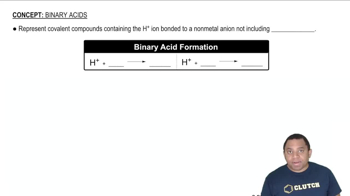
Binary Acids

Binary acids are acids that consist of only two elements, typically hydrogen and a nonmetal. The strength of binary acids is influenced by the bond strength between hydrogen and the nonmetal; weaker bonds lead to stronger acids. For example, in the case of HF and HCl, the H-F bond is stronger than the H-Cl bond, making HF a weaker acid than HCl despite fluorine's high electronegativity.
Video consigliato:

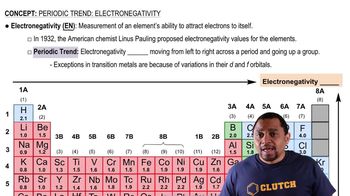
Electronegativity

Electronegativity is the tendency of an atom to attract electrons in a chemical bond. In binary acids, the electronegativity of the nonmetal affects the acid's strength; higher electronegativity typically leads to stronger acids due to the greater polarity of the H-X bond. For instance, in comparing HF and HCl, while HF has a highly electronegative fluorine, the bond strength ultimately results in HCl being the stronger acid.
Video consigliato:
Percorso guidato
02:10
Electronegativity Trends

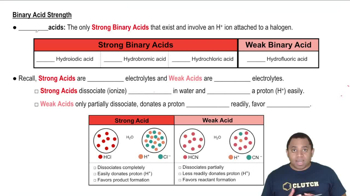
Bond Strength and Acid Strength

The strength of the bond between hydrogen and the nonmetal in a binary acid directly impacts the acid's strength. Weaker bonds are more easily broken, allowing the acid to donate protons (H+) more readily. For example, in the pair H2Se and H2S, the H-Se bond is weaker than the H-S bond, making H2Se the stronger acid because it can more easily release a proton.
Video consigliato:
Percorso guidato
03:51
Binary Acid Strengths