Ch.17 - Aqueous Ionic Equilibrium
Tro - Chemistry: A Molecular Approach 4th Edition
Tro4th EditionChemistry: A Molecular ApproachISBN: 9780134112831Non è quello che usi tu?Cambia libro di testo
Capitolo 17, Problema 59a

A 500.0-mL buffer solution is 0.100 M in HNO2 and 0.150 M in KNO2. Determine if each addition would exceed the capacity of the buffer to neutralize it. a. 250 mg NaOH

Guida verificata passo dopo passo
1
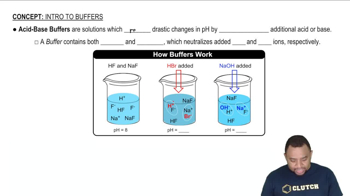
1. First, we need to understand what a buffer is. A buffer is a solution that can resist pH change upon the addition of an acidic or basic components. It is able to neutralize small amounts of added acid or base, thus maintaining the pH of the solution relatively stable. This is achieved by including a weak acid and its conjugate base in the solution. In this case, HNO2 is the weak acid and KNO2 is the salt of its conjugate base NO2-.
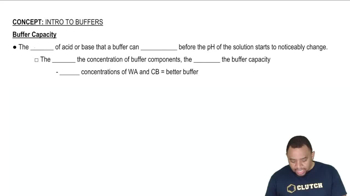
2. The capacity of a buffer is the amount of acid or base that can be added to it without causing a significant change in pH. It is directly proportional to the concentrations of the weak acid and its conjugate base in the buffer. In this case, the buffer is 0.100 M in HNO2 and 0.150 M in KNO2.
3. To determine if the addition of NaOH would exceed the buffer's capacity, we need to calculate the moles of NaOH added. NaOH is a strong base and will react with the weak acid HNO2 in the buffer. The molar mass of NaOH is approximately 40 g/mol. So, 250 mg (or 0.250 g) of NaOH is 0.250 g / 40 g/mol = 0.00625 mol.
4. The buffer can neutralize 0.100 mol/L * 0.500 L = 0.050 mol of NaOH. This is because the HNO2 can react with the OH- ions from the NaOH to form water and NO2- ions.
5. Compare the moles of NaOH added to the buffer's capacity. If the moles of NaOH added is less than or equal to the buffer's capacity, then the buffer can neutralize the added NaOH. If the moles of NaOH added is greater than the buffer's capacity, then the buffer cannot neutralize all of the added NaOH, and the pH of the solution will change significantly.

Risposta video verificata per un problema simile:

Questa soluzione video è stata consigliata dai nostri tutor come utile per risolvere questo problema.
Durata del video:
3m

Concetti chiave

Ecco i concetti essenziali che devi comprendere per rispondere correttamente alla domanda.

Buffer Solutions

Buffer solutions are mixtures that resist changes in pH when small amounts of acid or base are added. They typically consist of a weak acid and its conjugate base, or a weak base and its conjugate acid. In this case, HNO2 (a weak acid) and KNO2 (the salt of its conjugate base) form a buffer that can neutralize added acids or bases.
Video consigliato:
Percorso guidato
03:02
Buffer Solutions

Buffer Capacity

Buffer capacity refers to the amount of acid or base that a buffer solution can neutralize before a significant change in pH occurs. It depends on the concentrations of the buffer components; higher concentrations lead to greater capacity. In this scenario, the buffer's capacity will determine if the addition of NaOH exceeds its ability to maintain pH.
Video consigliato:
Percorso guidato
00:45
Buffer Capacity

Calculating Moles of Added Substance

To assess the impact of adding a substance like NaOH to a buffer, it's essential to calculate the number of moles being added. This is done using the formula: moles = mass (g) / molar mass (g/mol). For 250 mg of NaOH, converting to grams and then using its molar mass allows for determining how many moles are introduced to the buffer system.
Video consigliato: