Ch.17 - Aqueous Ionic Equilibrium
Tro - Chemistry: A Molecular Approach 4th Edition
Tro4th EditionChemistry: A Molecular ApproachISBN: 9780134112831Non è quello che usi tu?Cambia libro di testo
Capitolo 17, Problema 58

Which buffer system is the best choice to create a buffer with pH = 9.00? For the best system, calculate the ratio of the masses of the buffer components required to make the buffer. HF/KF HNO2/KNO2 NH3/NH4Cl HClO/KClO

Guida verificata passo dopo passo
1
Step 1: Identify the buffer systems and their corresponding weak acid or weak base and conjugate base or conjugate acid.
Step 2: Use the Henderson-Hasselbalch equation, which is pH = pKa + log([A-]/[HA]), to determine which buffer system has a pKa closest to the desired pH of 9.00.
Step 3: Calculate the pKa for each buffer system using the known Ka values or tables.
Step 4: Once the best buffer system is identified, use the Henderson-Hasselbalch equation to solve for the ratio [A-]/[HA] that gives a pH of 9.00.
Step 5: Convert the ratio of concentrations [A-]/[HA] to the ratio of masses using the molar masses of the buffer components.

Risposta video verificata per un problema simile:

Questa soluzione video è stata consigliata dai nostri tutor come utile per risolvere questo problema.
Durata del video:
2m

Concetti chiave

Ecco i concetti essenziali che devi comprendere per rispondere correttamente alla domanda.

Buffer Systems

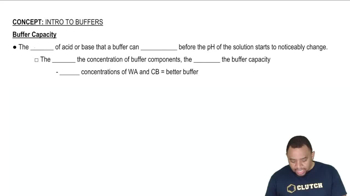
A buffer system is a solution that resists changes in pH upon the addition of small amounts of acid or base. It typically consists of a weak acid and its conjugate base or a weak base and its conjugate acid. The effectiveness of a buffer is determined by its pKa and the concentrations of its components, which help maintain a stable pH in a specific range.
Video consigliato:
Percorso guidato
00:45
Buffer Capacity

Henderson-Hasselbalch Equation

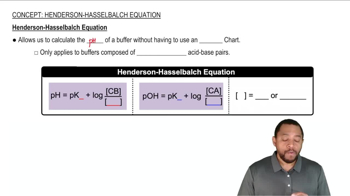
The Henderson-Hasselbalch equation relates the pH of a buffer solution to the pKa of the acid and the ratio of the concentrations of the conjugate base to the weak acid. It is expressed as pH = pKa + log([A-]/[HA]). This equation is essential for calculating the required ratio of buffer components to achieve a desired pH, such as 9.00 in this case.
Video consigliato:
Percorso guidato
02:40
Henderson-Hasselbalch Equation

pKa and pH Relationship

The pKa is the negative logarithm of the acid dissociation constant (Ka) and indicates the strength of an acid in solution. A lower pKa value corresponds to a stronger acid. For effective buffering, the pH of the solution should be close to the pKa of the weak acid used in the buffer system, allowing for optimal resistance to pH changes.
Video consigliato:
Percorso guidato
02:09
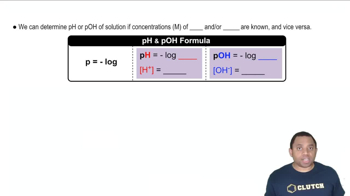
pH and pOH Calculations