
Ch.17 - Aqueous Ionic Equilibrium
Tro - Chemistry: A Molecular Approach 4th Edition
Tro4th EditionChemistry: A Molecular ApproachISBN: 9780134112831Non è quello che usi tu?Cambia libro di testo
Capitolo 17, Problema 65c

Consider the curve shown here for the titration of a weak monoprotic acid with a strong base and answer each question.
c. At what volume of added base does pH = pKa?

Guida verificata passo dopo passo
1
insert step 1> Identify that the point where pH = pK_a is the half-equivalence point in the titration of a weak acid with a strong base.
insert step 2> Understand that at the half-equivalence point, half of the weak acid has been neutralized by the base, and the concentrations of the acid and its conjugate base are equal.
insert step 3> Use the Henderson-Hasselbalch equation, which is pH = pK_a + \(\log\[\left\)(\(\frac{[A^-]}{[HA]}\]\right\)), to confirm that when [A^-] = [HA], pH = pK_a.
insert step 4> Determine the volume of base added at the equivalence point from the titration curve, which is the point where the curve shows a steep rise in pH.
insert step 5> Calculate the volume of base at the half-equivalence point by dividing the volume of base at the equivalence point by 2.

Risposta video verificata per un problema simile:

Questa soluzione video è stata consigliata dai nostri tutor come utile per risolvere questo problema.
Durata del video:
1m

Concetti chiave

Ecco i concetti essenziali che devi comprendere per rispondere correttamente alla domanda.

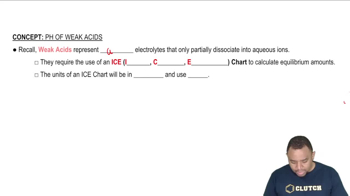
Weak Monoprotic Acid

A weak monoprotic acid is an acid that can donate one proton (H+) per molecule but does not completely dissociate in solution. This means that in a solution of a weak monoprotic acid, there exists an equilibrium between the undissociated acid and its ions. Understanding this concept is crucial for analyzing titration curves, as the behavior of the acid influences the pH changes during the titration process.
Video consigliato:
Percorso guidato
00:44
ICE Charts of Weak Acids

pK<sub>a</sub>

The pK<sub>a</sub> is a measure of the strength of an acid in solution, defined as the negative logarithm of the acid dissociation constant (K<sub>a</sub>). It indicates the pH at which the concentrations of the acid and its conjugate base are equal. In the context of titration, when the pH equals the pK<sub>a</sub>, it signifies that half of the acid has been neutralized, which is a critical point in understanding the titration curve.
Video consigliato:
Percorso guidato
01:10
Spin Quantum Numbers Example

Titration Curve

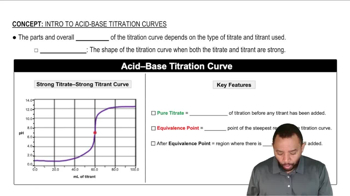
A titration curve is a graphical representation of the pH of a solution as a function of the volume of titrant added. For a weak acid titrated with a strong base, the curve typically shows a gradual increase in pH, followed by a steep rise near the equivalence point. The shape of the curve provides insights into the acid's dissociation and the buffering capacity of the solution, making it essential for determining key points such as where pH equals pK<sub>a</sub>.
Video consigliato:
Percorso guidato
02:16
Acid-Base Titration Curves