Ch.17 - Aqueous Ionic Equilibrium
Tro - Chemistry: A Molecular Approach 4th Edition
Tro4th EditionChemistry: A Molecular ApproachISBN: 9780134112831Non è quello che usi tu?Cambia libro di testo
Capitolo 17, Problema 63c

Two 20.0-mL samples, one 0.200 M KOH and the other 0.200 M CH3NH2, are titrated with 0.100 M HI. c. Which titration curve has the lower initial pH?

Guida verificata passo dopo passo
1
insert step 1> Determine the nature of the solutions: KOH is a strong base, while CH3NH2 is a weak base.
insert step 2> Understand that the initial pH of a solution is determined by the concentration and strength of the base.
insert step 3> Calculate the initial pH of the KOH solution: Since KOH is a strong base, it completely dissociates in water. Use the formula pH = 14 - pOH, where pOH = -\(\log\)[OH^-].
insert step 4> Calculate the initial pH of the CH3NH2 solution: As a weak base, CH3NH2 partially dissociates. Use the base dissociation constant (Kb) to find [OH^-] and then calculate pOH and pH.
insert step 5> Compare the initial pH values of both solutions: The solution with the lower pH will have the lower initial pH on the titration curve.

Risposta video verificata per un problema simile:

Questa soluzione video è stata consigliata dai nostri tutor come utile per risolvere questo problema.
Durata del video:
4m

Concetti chiave

Ecco i concetti essenziali che devi comprendere per rispondere correttamente alla domanda.

Acid-Base Titration

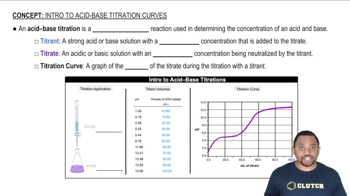
An acid-base titration is a quantitative analytical method used to determine the concentration of an acid or base in a solution. During the titration, a solution of known concentration (the titrant) is added to a solution of unknown concentration until the reaction reaches its equivalence point, where the amount of acid equals the amount of base. The pH of the solution changes throughout the titration, and the resulting curve can provide insights into the strengths of the acids and bases involved.
Video consigliato:
Percorso guidato
03:04
Acid-Base Titration

pH Scale

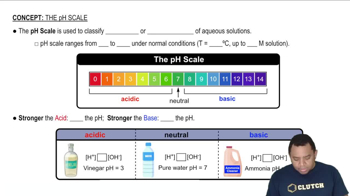
The pH scale measures the acidity or basicity of a solution, ranging from 0 to 14. A pH less than 7 indicates an acidic solution, while a pH greater than 7 indicates a basic solution. The pH is logarithmically related to the concentration of hydrogen ions (H+) in the solution, meaning that each whole number change on the scale represents a tenfold change in acidity. Understanding the initial pH of the solutions being titrated is crucial for predicting the behavior of the titration curve.
Video consigliato:

Weak Base vs. Strong Base

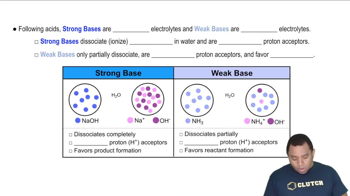
In this context, KOH is a strong base that completely dissociates in solution, while CH3NH2 (methylamine) is a weak base that only partially dissociates. The initial pH of a strong base solution is typically higher than that of a weak base solution due to the complete ionization of the strong base. This difference in dissociation affects the initial pH of the solutions before titration begins, which is essential for determining which titration curve will have a lower initial pH.
Video consigliato:
Percorso guidato
02:22
Strong vs Weak Bases