Ch.18 - Free Energy and Thermodynamics
Tro - Chemistry: A Molecular Approach 4th Edition
Tro4th EditionChemistry: A Molecular ApproachISBN: 9780134112831Non è quello che usi tu?Cambia libro di testo
Capitolo 18, Problema 33

What is the change in entropy that occurs in the system when 45.0 g of acetone (C3H6O) freezes at its melting point (-94.8 °C)? Use Table 11.9 for the heats of fusion.

Guida verificata passo dopo passo
1
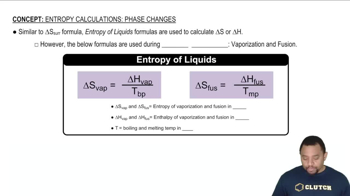
Identify the formula for calculating the change in entropy (\( \Delta S \)) during a phase change: \( \Delta S = \frac{q_{\text{rev}}}{T} \), where \( q_{\text{rev}} \) is the heat absorbed or released during the phase change and \( T \) is the temperature in Kelvin.
Convert the given mass of acetone (45.0 g) to moles using its molar mass (58.08 g/mol).
Use the heat of fusion for acetone from Table 11.9 to calculate \( q_{\text{rev}} \). The heat of fusion is the amount of energy required to change a substance from solid to liquid at its melting point.
Convert the temperature from Celsius to Kelvin by adding 273.15 to the given melting point (-94.8 °C).
Substitute the values of \( q_{\text{rev}} \) and \( T \) into the entropy change formula to find \( \Delta S \).

Concetti chiave

Ecco i concetti essenziali che devi comprendere per rispondere correttamente alla domanda.

Entropy

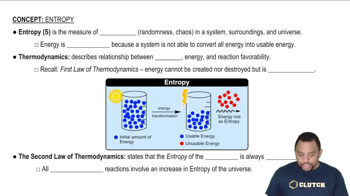
Entropy is a measure of the disorder or randomness in a system. In thermodynamics, it quantifies the number of ways a system can be arranged, with higher entropy indicating greater disorder. When a substance undergoes a phase change, such as freezing, the entropy of the system changes, reflecting the transition from a more disordered state (liquid) to a more ordered state (solid).
Video consigliato:
Percorso guidato
02:46
Entropy in Thermodynamics

Heats of Fusion

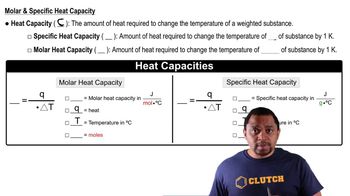
The heat of fusion is the amount of energy required to change a substance from solid to liquid at its melting point, or vice versa. This value is crucial for calculating the energy changes during phase transitions. In the context of freezing, the heat of fusion will be released as the substance transitions from liquid to solid, affecting the overall entropy of the system.
Video consigliato:

Phase Changes

Phase changes refer to the transitions between solid, liquid, and gas states of matter. Each phase has distinct properties and energy levels. When a substance freezes, it undergoes a phase change from liquid to solid, which involves a release of energy and a decrease in entropy, as the molecules become more ordered in the solid state.
Video consigliato:
Percorso guidato
01:46
Entropy in Phase Changes