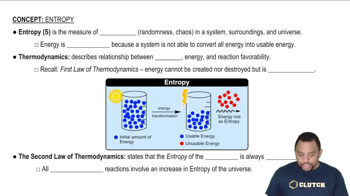
Without doing any calculations, determine the sign of ΔSsys for each chemical reaction. a. 2 KClO3(s) → 2 KCl(s) + 3 O2(g) c. Na(s) + 2 Cl2(g) → NaCl(s) d. N2(g) + 3 H2(g) → 2 NH3(g)
Ch.18 - Free Energy and Thermodynamics
Tro4th EditionChemistry: A Molecular ApproachISBN: 9780134112831Non è quello che usi tu?Cambia libro di testo
Capitolo 18, Problema 34
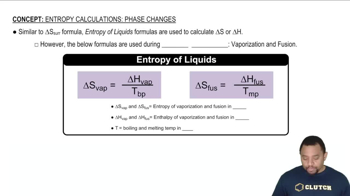
Calculate the change in entropy that occurs in the system when 55.0 g of water vaporizes from a liquid to a gas at its boiling point (100.0 °C). See Table 11.7 for heats of vaporization.
Guida verificata passo dopo passo1
Determine the number of moles of water: Use the molar mass of water (18.02 g/mol) to convert the mass of water (55.0 g) into moles.
Identify the heat of vaporization: Look up the heat of vaporization for water at its boiling point, which is typically given in kJ/mol.
Calculate the total heat absorbed: Multiply the number of moles of water by the heat of vaporization to find the total heat absorbed during the phase change.
Convert the heat absorbed to the same units as entropy: Since entropy is often expressed in J/K, convert the total heat absorbed from kJ to J.
Calculate the change in entropy: Use the formula \( \Delta S = \frac{q_{rev}}{T} \), where \( q_{rev} \) is the heat absorbed (in J) and \( T \) is the temperature in Kelvin (373 K for water at boiling point).
Concetti chiave
Ecco i concetti essenziali che devi comprendere per rispondere correttamente alla domanda.
Entropy
Entropy is a measure of the disorder or randomness in a system. In thermodynamics, it quantifies the amount of energy in a physical system that is not available to do work. When a substance changes state, such as from liquid to gas, the entropy typically increases because gas molecules have more freedom of movement and occupy a larger volume than liquid molecules.
Video consigliato:
Percorso guidato
Entropy in Thermodynamics
Heat of Vaporization
The heat of vaporization is the amount of energy required to convert a unit mass of a substance from liquid to gas at its boiling point without changing its temperature. This value is crucial for calculating the change in entropy during phase transitions, as it directly relates to the energy input needed for vaporization, which influences the disorder of the system.
Video consigliato:
Percorso guidato
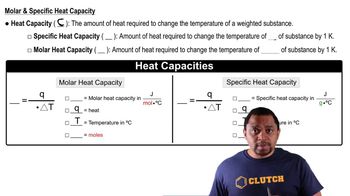
Heat Capacity
Phase Change and Temperature
Phase changes, such as vaporization, occur at specific temperatures where the substance can transition between states. For water, the boiling point is 100.0 °C at standard atmospheric pressure. Understanding the relationship between temperature and phase changes is essential for calculating thermodynamic properties like entropy, as these transitions involve significant energy changes while maintaining constant temperature.
Video consigliato:
Percorso guidato
Entropy in Phase Changes
Pratica correlata
Domanda del libro di testo
3407
views
Domanda del libro di testo
Without doing any calculations, determine the sign of ΔSsys for each chemical reaction. a. Mg(s) + Cl2(g) → MgCl2(s) b. 2 H2S(g) + 3 O2(g) → 2 H2O(g) + 2 SO2(g) c. 2 O3(g) → 3 O2(g) d. HCl(g) + NH3(g) → NH4Cl(s)
Domanda del libro di testo
Calculate the change in entropy that occurs in the system when 1.00 mole of isopropyl alcohol (C3H8O) melts at its melting point (-89.5 °C). See Table 11.9 for heats of fusion.
2701
views
1
rank
1
comments
Domanda del libro di testo
Calculate the change in entropy that occurs in the system when 1.00 mole of diethyl ether (C4H10O) condenses from a gas to a liquid at its normal boiling point (34.6 °C). See Table 11.7 for heats of vaporization.
2997
views
Domanda del libro di testo
Without doing any calculations, determine the sign of ΔSsys for each chemical reaction. b. CH2=CH2( g) + H2( g) → CH3CH3( g)
463
views
1
rank