
Ch.18 - Free Energy and Thermodynamics
Tro - Chemistry: A Molecular Approach 4th Edition
Tro4th EditionChemistry: A Molecular ApproachISBN: 9780134112831Non è quello che usi tu?Cambia libro di testo
Capitolo 18, Problema 43

Calculate the change in Gibbs free energy for each set of ΔHrxn, ΔSrxn, and T given in Problem 41. Predict whether or not each reaction is spontaneous at the temperature indicated. (Assume that all reactants and products are in their standard states.)

Guida verificata passo dopo passo
1
Identify the given values for each reaction: \( \Delta H_{rxn} \) (enthalpy change), \( \Delta S_{rxn} \) (entropy change), and \( T \) (temperature in Kelvin).
Use the Gibbs free energy equation: \( \Delta G = \Delta H - T \Delta S \) to calculate the change in Gibbs free energy for each reaction.
Substitute the given values into the equation for each reaction to find \( \Delta G \).
Determine the spontaneity of each reaction: if \( \Delta G < 0 \), the reaction is spontaneous; if \( \Delta G > 0 \), the reaction is non-spontaneous.
Summarize the results for each reaction, indicating whether it is spontaneous or not at the given temperature.

Concetti chiave

Ecco i concetti essenziali che devi comprendere per rispondere correttamente alla domanda.

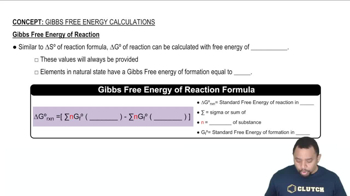
Gibbs Free Energy (G)

Gibbs free energy is a thermodynamic potential that measures the maximum reversible work obtainable from a thermodynamic system at constant temperature and pressure. It is defined by the equation G = H - TS, where H is enthalpy, T is temperature, and S is entropy. A negative change in Gibbs free energy (ΔG < 0) indicates that a reaction is spontaneous, while a positive change (ΔG > 0) suggests non-spontaneity.
Video consigliato:
Percorso guidato
01:51
Gibbs Free Energy of Reactions

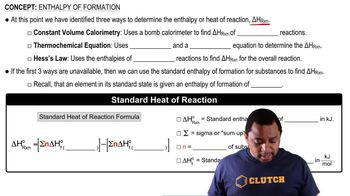
Enthalpy (ΔH)

Enthalpy is a measure of the total heat content of a system and is used to quantify the energy changes during chemical reactions. The change in enthalpy (ΔH) can be either positive or negative, indicating whether a reaction absorbs heat (endothermic, ΔH > 0) or releases heat (exothermic, ΔH < 0). This value is crucial for determining the spontaneity of a reaction when combined with entropy changes.
Video consigliato:
Percorso guidato
02:34
Enthalpy of Formation

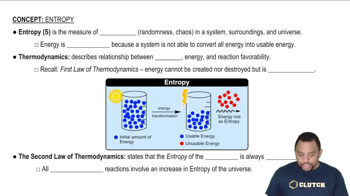
Entropy (ΔS)

Entropy is a measure of the disorder or randomness in a system. The change in entropy (ΔS) during a reaction reflects how the distribution of energy changes, with positive ΔS indicating increased disorder and negative ΔS indicating decreased disorder. In the context of Gibbs free energy, a positive ΔS can favor spontaneity, especially at higher temperatures, as it contributes to a more negative ΔG.
Video consigliato:
Percorso guidato
02:46
Entropy in Thermodynamics