Ch.18 - Free Energy and Thermodynamics
Tro - Chemistry: A Molecular Approach 4th Edition
Tro4th EditionChemistry: A Molecular ApproachISBN: 9780134112831Non è quello che usi tu?Cambia libro di testo
Capitolo 18, Problema 47

Fill in the blanks in the table. Both ΔH and ΔS refer to the system.

Guida verificata passo dopo passo
1
Identify the given values in the problem, such as \( \Delta H \) (enthalpy change) and \( \Delta S \) (entropy change) for the system.
Recall the relationship between \( \Delta G \) (Gibbs free energy change), \( \Delta H \), and \( \Delta S \) using the equation: \( \Delta G = \Delta H - T \Delta S \), where \( T \) is the temperature in Kelvin.
Determine if any additional information is provided, such as temperature or specific conditions, to calculate the missing values.
Use the equation \( \Delta G = \Delta H - T \Delta S \) to solve for the missing variable, ensuring all units are consistent (e.g., converting \( \Delta S \) from J/mol·K to kJ/mol·K if necessary).
Check your work by verifying that the calculated values make sense in the context of the problem, such as ensuring that the signs of \( \Delta H \) and \( \Delta S \) align with the expected spontaneity of the reaction.

Risposta video verificata per un problema simile:

Questa soluzione video è stata consigliata dai nostri tutor come utile per risolvere questo problema.
Durata del video:
3m

Concetti chiave

Ecco i concetti essenziali che devi comprendere per rispondere correttamente alla domanda.

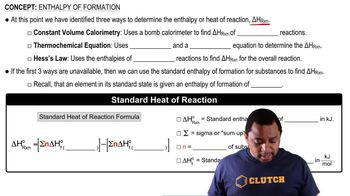
Enthalpy (ΔH)

Enthalpy (ΔH) is a thermodynamic quantity that represents the total heat content of a system. It reflects the energy required to create a system at constant pressure and is crucial for understanding heat transfer during chemical reactions. A positive ΔH indicates an endothermic process, while a negative ΔH signifies an exothermic reaction.
Video consigliato:
Percorso guidato
02:34
Enthalpy of Formation

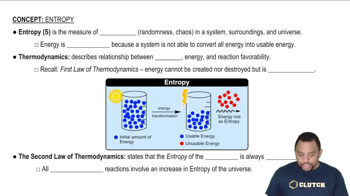
Entropy (ΔS)

Entropy (ΔS) is a measure of the disorder or randomness in a system. It quantifies the number of ways a system can be arranged, with higher entropy indicating greater disorder. In thermodynamics, changes in entropy help predict the spontaneity of a process; a positive ΔS often favors spontaneity, while a negative ΔS may hinder it.
Video consigliato:
Percorso guidato
02:46
Entropy in Thermodynamics

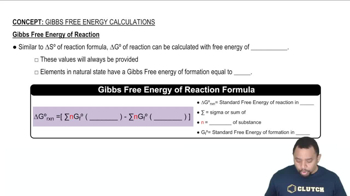
Gibbs Free Energy (ΔG)

Gibbs Free Energy (ΔG) combines enthalpy and entropy to determine the spontaneity of a process at constant temperature and pressure. The relationship is given by the equation ΔG = ΔH - TΔS, where T is the temperature in Kelvin. A negative ΔG indicates a spontaneous process, while a positive ΔG suggests non-spontaneity.
Video consigliato:
Percorso guidato
01:51
Gibbs Free Energy of Reactions
Pratica correlata
Domanda del libro di testo

How does the molar entropy of a substance change with increasing temperature?

889
views

Domanda del libro di testo

Predict the conditions (high temperature, low temperature, all temperatures, or no temperatures) under which each reaction is spontaneous. a. H2O(g) → H2O(l) b. CO2(s) → CO2(g) c. H2(g) → 2 H(g) d. 2 NO2(g) → 2 NO(g) + O2(g) (endothermic)

1573
views
Domanda del libro di testo

For each pair of substances, choose the one that you expect to have the higher standard molar entropy (S°) at 25 °C. Explain your choices. a. CO(g); CO2(g) b. CH3OH(l); CH3OH(g) c. Ar(g); CO2(g) d. CH4(g); SiH4(g) e. NO2(g); CH3CH2CH3(g) f. NaBr(s); NaBr(aq)

1639
views
Domanda del libro di testo

Calculate the free energy change for this reaction at 25 °C. Is the reaction spontaneous? (Assume that all reactants and products are in their standard states.) C3H8(g) + 5 O2(g) → 3 CO2(g) + 4 H2O(g) ΔH°rxn = -2217 kJ; ΔS°rxn = 101.1 J/K

Domanda del libro di testo

Calculate the change in Gibbs free energy for each of the sets of ΔHrxn, ΔSrxn, and T given in Problem 42. Predict whether or not each reaction is spontaneous at the temperature indicated. (Assume that all reactants and products are in their standard states.)

3067
views
Domanda del libro di testo

Calculate the free energy change for this reaction at 25 °C. Is the reaction spontaneous? (Assume that all reactants and products are in their standard states.) 2 Ca(s) + O2( g) → 2 CaO(s) ΔH°rxn = -1269.8 kJ; ΔS°rxn = -364.6 J/K

4891
views
1
rank