Ch.19 - Electrochemistry
Tro - Chemistry: A Molecular Approach 4th Edition
Tro4th EditionChemistry: A Molecular ApproachISBN: 9780134112831Non è quello che usi tu?Cambia libro di testo
Capitolo 19, Problema 96b,c

Write equations for the half-reactions that occur at the anode and cathode for the electrolysis of each aqueous solution. b. KCl(aq) c. CuBr2(aq)

Guida verificata passo dopo passo
1
Step 1: Identify the ions present in the aqueous solution of KCl. In KCl(aq), the ions are K⁺ and Cl⁻. Water (H₂O) is also present and can participate in the electrolysis reactions.
Step 2: Determine the possible half-reactions at the anode for KCl(aq). At the anode, oxidation occurs. The possible reactions are the oxidation of Cl⁻ to Cl₂ gas and the oxidation of water to oxygen gas.
Step 3: Write the half-reaction for the oxidation of Cl⁻ at the anode: 2Cl⁻(aq) → Cl₂(g) + 2e⁻. This reaction is more favorable than the oxidation of water under standard conditions.
Step 4: Identify the ions present in the aqueous solution of CuBr₂. In CuBr₂(aq), the ions are Cu²⁺ and Br⁻. Water is also present.
Step 5: Determine the possible half-reactions at the cathode for CuBr₂(aq). At the cathode, reduction occurs. The possible reactions are the reduction of Cu²⁺ to Cu(s) and the reduction of water to hydrogen gas. Write the half-reaction for the reduction of Cu²⁺ at the cathode: Cu²⁺(aq) + 2e⁻ → Cu(s). This reaction is more favorable than the reduction of water under standard conditions.

Risposta video verificata per un problema simile:

Questa soluzione video è stata consigliata dai nostri tutor come utile per risolvere questo problema.
Durata del video:
3m

Concetti chiave

Ecco i concetti essenziali che devi comprendere per rispondere correttamente alla domanda.

Electrolysis

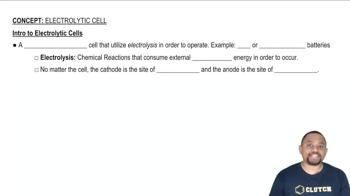
Electrolysis is a chemical process that uses electrical energy to drive a non-spontaneous reaction. In this process, an electric current is passed through an electrolyte, causing the decomposition of the compound into its constituent elements. The reactions occur at two electrodes: the anode (positive electrode) and the cathode (negative electrode), where oxidation and reduction reactions take place, respectively.
Video consigliato:
Percorso guidato
01:21
The Electrolytic Cell

Half-Reactions

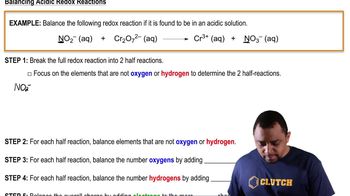
Half-reactions are the individual oxidation or reduction reactions that occur at the electrodes during electrolysis. Each half-reaction shows the transfer of electrons and the change in oxidation states of the species involved. By writing half-reactions, one can clearly identify what is being oxidized at the anode and what is being reduced at the cathode, which is essential for understanding the overall electrochemical process.
Video consigliato:
Percorso guidato
07:19
Redox Half Reactions Example

Electrolyte Solutions

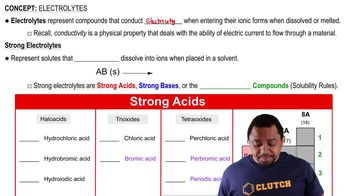
Electrolyte solutions are aqueous solutions that contain ions, which are necessary for conducting electricity. The nature of the electrolyte affects the products formed during electrolysis. For example, in KCl(aq), chloride ions can be oxidized at the anode, while in CuBr2(aq), copper ions can be reduced at the cathode, leading to different half-reactions based on the specific ions present in the solution.
Video consigliato:
Percorso guidato
02:50
Electrolytes and Strong Acids