Ch.2 - Atoms & Elements
Tro - Chemistry: A Molecular Approach 4th Edition
Tro4th EditionChemistry: A Molecular ApproachISBN: 9780134112831Non è quello che usi tu?Cambia libro di testo
Capitolo 2, Problema 59

Predict the charge of the ion formed by each element. a. O b. K c. Al d. Rb

Guida verificata passo dopo passo
1
Identify the group number of each element in the periodic table.
Determine the number of valence electrons for each element based on its group number.
Predict whether the element will lose or gain electrons to achieve a stable electron configuration, typically a full outer shell.
For elements that lose electrons, the charge of the ion is positive and equal to the number of electrons lost. For elements that gain electrons, the charge is negative and equal to the number of electrons gained.
Apply this logic to each element: a. Oxygen (O) is in Group 16, b. Potassium (K) is in Group 1, c. Aluminum (Al) is in Group 13, d. Rubidium (Rb) is in Group 1.

Risposta video verificata per un problema simile:

Questa soluzione video è stata consigliata dai nostri tutor come utile per risolvere questo problema.
Durata del video:
1m

Concetti chiave

Ecco i concetti essenziali che devi comprendere per rispondere correttamente alla domanda.

Ion Formation

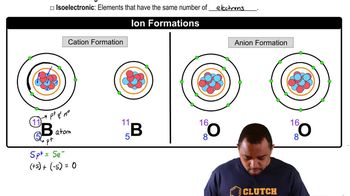
Ion formation occurs when atoms gain or lose electrons to achieve a stable electron configuration, typically resembling that of the nearest noble gas. Elements tend to form ions to reach a full outer shell, which is often achieved by losing or gaining a specific number of electrons.
Video consigliato:

Electronegativity and Ion Charges

Electronegativity is a measure of an atom's ability to attract and hold onto electrons. Elements with high electronegativity, like oxygen, tend to gain electrons and form negative ions (anions), while those with low electronegativity, like potassium and rubidium, tend to lose electrons and form positive ions (cations).
Video consigliato:
Percorso guidato
01:39
Polyatomic Ion Charges

Group Trends in the Periodic Table

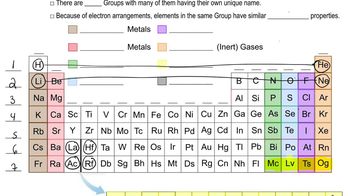
The periodic table is organized into groups (columns) that share similar chemical properties. Elements in Group 1 (alkali metals) typically form +1 ions, while those in Group 2 (alkaline earth metals) form +2 ions. Nonmetals, such as oxygen in Group 16, usually form anions with a charge of -2.
Video consigliato:
Percorso guidato
05:33
Periodic Table: Group Names