A sample of F-18 has an initial decay rate of 1.5⨉105/s. How long will it take for the decay rate to fall to 2.5⨉103/s? (F-18 has a half-life of 1.83 hours.)
Guida verificata passo dopo passo
1
Identify the initial decay rate \( R_0 = 1.5 \times 10^5 \text{ s}^{-1} \) and the final decay rate \( R = 2.5 \times 10^3 \text{ s}^{-1} \).
Use the half-life formula for radioactive decay: \( R = R_0 \times \left( \frac{1}{2} \right)^{\frac{t}{t_{1/2}}} \), where \( t_{1/2} = 1.83 \text{ hours} \).
Rearrange the formula to solve for time \( t \): \( t = t_{1/2} \times \frac{\log\left(\frac{R}{R_0}\right)}{\log\left(\frac{1}{2}\right)} \).
Substitute the known values into the equation: \( t = 1.83 \times \frac{\log\left(\frac{2.5 \times 10^3}{1.5 \times 10^5}\right)}{\log\left(\frac{1}{2}\right)} \).
Calculate the value of \( t \) to find the time it takes for the decay rate to fall to the desired level.
Risposta video verificata per un problema simile:
Questa soluzione video è stata consigliata dai nostri tutor come utile per risolvere questo problema.
Durata del video:
4m
Guarda un video:
0 Commenti
Concetti chiave
Ecco i concetti essenziali che devi comprendere per rispondere correttamente alla domanda.
Radioactive Decay
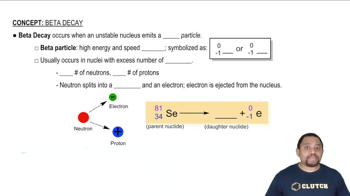
Radioactive decay is the process by which unstable atomic nuclei lose energy by emitting radiation. This decay occurs at a characteristic rate for each isotope, often described by its decay constant, which is related to the half-life. Understanding this concept is crucial for calculating how the decay rate changes over time.
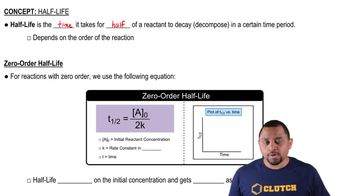
Half-life is the time required for half of the radioactive nuclei in a sample to decay. For F-18, the half-life is 1.83 hours, meaning that after this time, half of the original amount of F-18 will have decayed. This concept is essential for determining the time it takes for the decay rate to decrease from an initial value to a specified lower value.
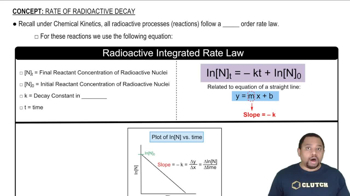
The exponential decay formula describes how the quantity of a radioactive substance decreases over time. It is expressed as N(t) = N0 * e^(-λt), where N(t) is the quantity at time t, N0 is the initial quantity, λ is the decay constant, and e is the base of the natural logarithm. This formula is fundamental for calculating the time required for the decay rate to reach a specific value.


 Guida verificata passo dopo passo
 03:00
03:00