Ch.20 - Radioactivity and Nuclear Chemistry
Tro - Chemistry: A Molecular Approach 4th Edition
Tro4th EditionChemistry: A Molecular ApproachISBN: 9780134112831Non è quello che usi tu?Cambia libro di testo
Capitolo 20, Problema 51

A wooden boat discovered just south of the Great Pyramid in Egypt has a carbon-14 to carbon-12 ratio that is 72.5% of that found in living organisms. How old is the boat?

Guida verificata passo dopo passo
1
Understand that the problem involves radiocarbon dating, which uses the decay of carbon-14 to estimate the age of organic materials.
Recall that the half-life of carbon-14 is approximately 5730 years. This is the time it takes for half of the carbon-14 in a sample to decay.
Use the formula for radioactive decay: \( N(t) = N_0 \times (0.5)^{t/T} \), where \( N(t) \) is the remaining amount of carbon-14, \( N_0 \) is the initial amount, \( t \) is the time that has passed, and \( T \) is the half-life.
Set up the equation using the given ratio: \( 0.725 = (0.5)^{t/5730} \). This represents the fact that the carbon-14 to carbon-12 ratio is 72.5% of the original.
Solve for \( t \) by taking the natural logarithm of both sides and rearranging the equation to find the age of the boat.

Concetti chiave

Ecco i concetti essenziali che devi comprendere per rispondere correttamente alla domanda.

Carbon-14 Dating

Carbon-14 dating is a radiometric dating method used to determine the age of organic materials by measuring the ratio of carbon-14 to carbon-12 isotopes. Living organisms continuously exchange carbon with their environment, maintaining a constant ratio of these isotopes. Upon death, the carbon-14 begins to decay at a known rate (its half-life is about 5730 years), allowing scientists to estimate the time since the organism's death based on the remaining carbon-14.
Video consigliato:
Percorso guidato
03:48
3 and 4 Carbon Alkyls

Half-Life

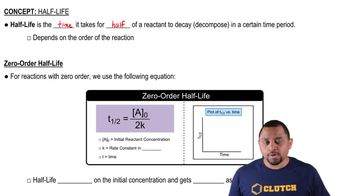
The half-life of a radioactive isotope is the time required for half of the isotope in a sample to decay into a different element or isotope. For carbon-14, this period is approximately 5730 years. Understanding half-life is crucial for calculating the age of an object based on the remaining amount of carbon-14, as it provides a consistent measure of decay over time.
Video consigliato:
Percorso guidato
02:17
Zero-Order Half-life

Radioactive Decay and Ratios

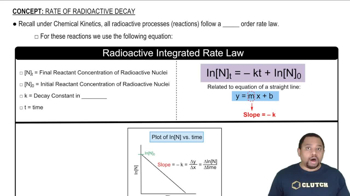
Radioactive decay refers to the process by which unstable atomic nuclei lose energy by emitting radiation. The ratio of carbon-14 to carbon-12 in a sample can indicate how long it has been since the organism died. In this case, the boat's carbon-14 to carbon-12 ratio being 72.5% of that in living organisms suggests a specific amount of time has passed, which can be calculated using the known decay rate of carbon-14.
Video consigliato:
Percorso guidato
03:00
Rate of Radioactive Decay