Ch.21 - Organic Chemistry
Tro - Chemistry: A Molecular Approach 4th Edition
Tro4th EditionChemistry: A Molecular ApproachISBN: 9780134112831Non è quello che usi tu?Cambia libro di testo
Capitolo 21, Problema 59b

Complete each hydrogenation reaction. b.

Guida verificata passo dopo passo
1
Identify the reactant involved in the hydrogenation reaction. Typically, this will be an unsaturated hydrocarbon such as an alkene or alkyne.
Understand that hydrogenation involves the addition of hydrogen (H₂) across the double or triple bonds of the unsaturated hydrocarbon, converting it into a saturated hydrocarbon.
Write the balanced chemical equation for the reaction. For example, if the reactant is an alkene, the general reaction is: \[ \text{R-CH=CH-R'} + \text{H}_2 \rightarrow \text{R-CH}_2\text{-CH}_2\text{-R'} \]
Determine the conditions required for the reaction to proceed, such as the presence of a catalyst (commonly palladium, platinum, or nickel) and appropriate temperature and pressure.
Predict the product of the hydrogenation reaction, which will be a saturated hydrocarbon, and ensure that the equation is balanced in terms of both atoms and charge.

Risposta video verificata per un problema simile:

Questa soluzione video è stata consigliata dai nostri tutor come utile per risolvere questo problema.
Durata del video:
40s

Concetti chiave

Ecco i concetti essenziali che devi comprendere per rispondere correttamente alla domanda.

Hydrogenation

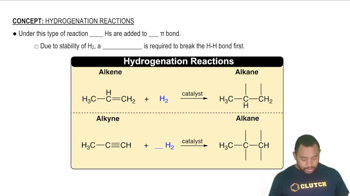
Hydrogenation is a chemical reaction that involves the addition of hydrogen (H2) to an unsaturated compound, typically an alkene or alkyne, converting it into a saturated compound. This process is commonly used in organic chemistry to reduce double or triple bonds, resulting in alkanes. Catalysts, such as palladium, platinum, or nickel, are often employed to facilitate the reaction.
Video consigliato:
Percorso guidato
01:22
Hydrogenation Reactions

Reaction Mechanism

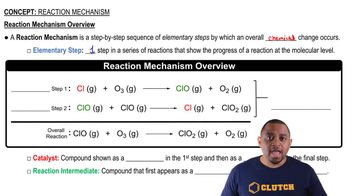
The reaction mechanism describes the step-by-step sequence of elementary reactions by which overall chemical change occurs. Understanding the mechanism of hydrogenation is crucial, as it involves the formation of intermediates and the role of catalysts. This knowledge helps predict the products and the conditions required for the reaction to proceed efficiently.
Video consigliato:
Percorso guidato
03:06
Reaction Mechanism Overview

Saturation and Unsaturation

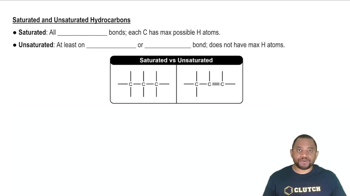
In organic chemistry, saturation refers to the presence of single bonds between carbon atoms, while unsaturation indicates the presence of double or triple bonds. Saturated compounds, like alkanes, are generally more stable and less reactive than unsaturated compounds, such as alkenes and alkynes. Recognizing the degree of saturation is essential for predicting the outcome of hydrogenation reactions.
Video consigliato:
Percorso guidato
02:12
Saturated and Unsaturated Hydrocarbons