Ch.21 - Organic Chemistry
Tro - Chemistry: A Molecular Approach 4th Edition
Tro4th EditionChemistry: A Molecular ApproachISBN: 9780134112831Non è quello che usi tu?Cambia libro di testo
Capitolo 21, Problema 58c

What are the products of each alkene addition reaction? c.

Guida verificata passo dopo passo
1
Identify the type of alkene addition reaction being asked about. Common types include hydrogenation, halogenation, hydrohalogenation, and hydration.
Determine the structure of the alkene involved in the reaction. Alkenes are hydrocarbons with at least one carbon-carbon double bond (C=C).
For each type of addition reaction, identify the reagents and conditions. For example, hydrogenation involves H2 and a metal catalyst, while halogenation involves a halogen like Br2 or Cl2.
Predict the product by adding the elements of the reagent across the double bond of the alkene. For example, in halogenation, each carbon of the double bond will bond with one halogen atom.
Consider any possible stereochemistry or regioselectivity that might affect the product, such as Markovnikov's rule in hydrohalogenation, which states that the hydrogen atom will add to the carbon with more hydrogen atoms already attached.

Risposta video verificata per un problema simile:

Questa soluzione video è stata consigliata dai nostri tutor come utile per risolvere questo problema.
Durata del video:
2m

Concetti chiave

Ecco i concetti essenziali che devi comprendere per rispondere correttamente alla domanda.

Alkene Structure

Alkenes are hydrocarbons that contain at least one carbon-carbon double bond (C=C). This double bond is a key feature that influences their reactivity, making them more reactive than alkanes. The presence of the double bond allows alkenes to undergo various addition reactions, where atoms or groups are added across the double bond, resulting in the formation of new compounds.
Video consigliato:
Percorso guidato
02:47
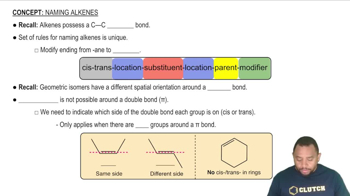
Rules for Naming Alkenes

Addition Reactions

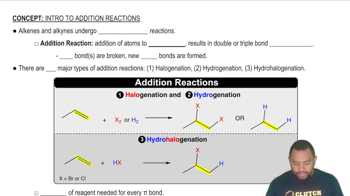
Addition reactions involve the addition of atoms or groups to the carbon atoms of a double bond in alkenes. Common types of addition reactions include hydrogenation (adding H2), halogenation (adding X2), and hydrohalogenation (adding HX). Each type of addition reaction produces different products, depending on the reagents used and the conditions of the reaction.
Video consigliato:
Percorso guidato
02:55
Addition Reactions

Markovnikov's Rule

Markovnikov's Rule is a principle that predicts the outcome of certain addition reactions involving alkenes. It states that when HX is added to an asymmetric alkene, the hydrogen atom will attach to the carbon with the greater number of hydrogen atoms already attached, while the halide (X) will attach to the carbon with fewer hydrogen atoms. This rule helps in determining the major product of the reaction and is crucial for understanding regioselectivity in alkene addition.
Video consigliato:
Percorso guidato
00:28
Solubility Rules