Ch.4 - Chemical Quantities & Aqueous Reactions
Tro - Chemistry: A Molecular Approach 4th Edition
Tro4th EditionChemistry: A Molecular ApproachISBN: 9780134112831Non è quello che usi tu?Cambia libro di testo
Capitolo 4, Problema 41

Calculate the theoretical yield of the product (in moles) for each initial amount of reactants.
Ti(s) + 2 Cl2(g) → TiCl4(s)
a. 4 mol Ti, 4 mol Cl2
b. 7 mol Ti, 17 mol Cl2
c. 12.4 mol Ti, 18.8 mol Cl2

Guida verificata passo dopo passo
1
Determine the balanced chemical equation for the reaction: Ti(s) + 2 \(\text{Cl}\)_2(g) \(\rightarrow\) \(\text{TiCl}\)_4(s)
Identify the stoichiometric coefficients from the balanced equation: 1 mol of Ti reacts with 2 mol of Cl_2 to produce 1 mol of TiCl_4.
Calculate the moles of TiCl_4 that can be produced from 7 mol of Ti: Since 1 mol of Ti produces 1 mol of TiCl_4, 7 mol of Ti can produce 7 mol of TiCl_4.
Calculate the moles of TiCl_4 that can be produced from 17 mol of Cl_2: Since 2 mol of Cl_2 are needed to produce 1 mol of TiCl_4, 17 mol of Cl_2 can produce 17/2 = 8.5 mol of TiCl_4.
Determine the theoretical yield by identifying the limiting reactant: The limiting reactant is Ti, as it produces fewer moles of TiCl_4 (7 mol) compared to Cl_2 (8.5 mol). Therefore, the theoretical yield of TiCl_4 is 7 mol.

Risposta video verificata per un problema simile:

Questa soluzione video è stata consigliata dai nostri tutor come utile per risolvere questo problema.
Durata del video:
3m

Concetti chiave

Ecco i concetti essenziali che devi comprendere per rispondere correttamente alla domanda.

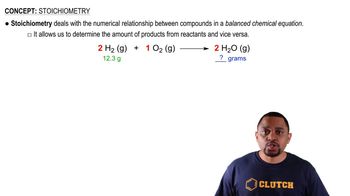
Stoichiometry

Stoichiometry is the branch of chemistry that deals with the quantitative relationships between reactants and products in a chemical reaction. It allows chemists to predict the amounts of substances consumed and produced in a reaction based on balanced chemical equations. Understanding stoichiometry is essential for calculating theoretical yields, as it provides the mole ratios needed to determine how much product can be formed from given amounts of reactants.
Video consigliato:
Percorso guidato
01:16
Stoichiometry Concept

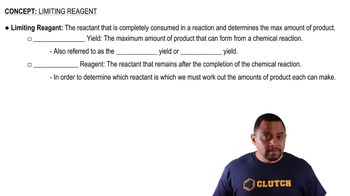
Limiting Reactant

The limiting reactant is the substance that is completely consumed first in a chemical reaction, thus determining the maximum amount of product that can be formed. Identifying the limiting reactant is crucial for yield calculations, as it dictates the extent of the reaction. In the given reaction, comparing the mole ratios of Ti and Cl2 will reveal which reactant limits the formation of TiCl4.
Video consigliato:
Percorso guidato
01:30
Limiting Reagent Concept

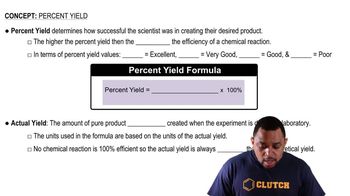
Theoretical Yield

Theoretical yield is the maximum amount of product that can be generated from a given amount of reactants, calculated based on the stoichiometry of the balanced equation. It assumes complete conversion of the limiting reactant with no losses or side reactions. Theoretical yield is expressed in moles or grams and is a key concept in evaluating the efficiency of a chemical reaction.
Video consigliato:
Percorso guidato
03:09
Percent Yield in Reactions
Pratica correlata
Domanda del libro di testo

Calculate the theoretical yield of product (in moles) for each initial amount of reactants.

3 Mn(s) + 2 O2(g) → Mn3O4(s)

a. 3 mol Mn, 2 mol O2

b. 4 mol Mn, 7 mol O2

c. 27.5 mol Mn, 43.8 mol O2

3761
views
1
rank

Domanda del libro di testo

Zinc sulfide reacts with oxygen according to the reaction: 2 ZnS(s) + 3 O2(g) → 2 ZnO(s) + 2 SO2( g) A reaction mixture initially contains 4.2 mol ZnS and 6.8 mol O2. Once the reaction has occurred as completely as possible, what amount (in moles) of the excess reactant remains?

7103
views
1
comments
Domanda del libro di testo

Find the limiting reactant for each initial amount of reactants. 4 Al(s) + 3 O2( g) → 2 Al2O3(s)

a. 1 mol Al, 1 mol O2

b. 4 mol Al, 2.6 mol O2

c. 16 mol Al, 13 mol O2

d. 7.4 mol Al, 6.5 mol O2

3015
views
1
comments
Domanda del libro di testo

Iron(II) sulfide reacts with hydrochloric acid according to the reaction: FeS(s) + 2 HCl(aq) → FeCl2(s) + H2S(g) A reaction mixture initially contains 0.223 mol FeS and 0.652 mol HCl. Once the reaction has occurred as completely as possible, what amount (in moles) of the excess reactant remains?

8939
views
1
rank
Domanda del libro di testo

Consider the reaction: 4 HCl(g) + O2(g) → 2 H2O(g) + 2 Cl2(g) Each molecular diagram represents an initial mixture of reactants. How many molecules of Cl2 form from the reaction mixture that produces the greatest amount of products?

2250
views
3
rank
Domanda del libro di testo

Consider the reaction: 2 CH3OH(g) + 3 O2(g) → 2 CO2(g) + 4 H2O(g) Each of the molecular diagrams represents an initial mixture of the reactants. How many CO2 molecules form from the reaction mixture that produces the greatest amount of products?

2725
views
1
comments