Ch.4 - Chemical Quantities & Aqueous Reactions
Tro - Chemistry: A Molecular Approach 4th Edition
Tro4th EditionChemistry: A Molecular ApproachISBN: 9780134112831Non è quello che usi tu?Cambia libro di testo
Capitolo 4, Problema 40

Consider the reaction: 2 CH3OH(g) + 3 O2(g) → 2 CO2(g) + 4 H2O(g) Each of the molecular diagrams represents an initial mixture of the reactants. How many CO2 molecules form from the reaction mixture that produces the greatest amount of products?

Guida verificata passo dopo passo
1
Identify the balanced chemical equation: 2 \(\text{CH}\)_3\(\text{OH}\)(g) + 3 \(\text{O}\)_2(g) \(\rightarrow\) 2 \(\text{CO}\)_2(g) + 4 \(\text{H}\)_2\(\text{O}\)(g)
Determine the stoichiometric ratios from the balanced equation: 2 \(\text{CH}\)_3\(\text{OH}\) : 3 \(\text{O}\)_2 : 2 \(\text{CO}\)_2 : 4 \(\text{H}\)_2\(\text{O}\)
Examine the molecular diagrams to count the number of \(\text{CH}\)_3\(\text{OH}\) and \(\text{O}\)_2} molecules available initially.
Identify the limiting reactant by comparing the available molecules to the stoichiometric ratios.
Calculate the maximum number of \(\text{CO}\)_2 molecules that can be formed based on the limiting reactant using the stoichiometric ratio: \(\text{Limiting Reactant}\) \(\rightarrow\) \(\text{CO}\)_2.

Risposta video verificata per un problema simile:

Questa soluzione video è stata consigliata dai nostri tutor come utile per risolvere questo problema.
Durata del video:
10m

Concetti chiave

Ecco i concetti essenziali che devi comprendere per rispondere correttamente alla domanda.

Stoichiometry

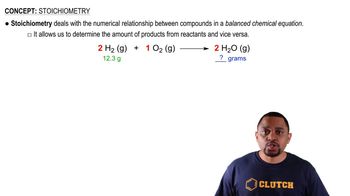
Stoichiometry is the calculation of reactants and products in chemical reactions based on the balanced equation. It allows us to determine the proportions of each substance involved in the reaction. In this case, the coefficients in the balanced equation indicate that for every 2 moles of CH₃OH consumed, 2 moles of CO₂ are produced, establishing a direct relationship between the reactants and products.
Video consigliato:
Percorso guidato
01:16
Stoichiometry Concept

Limiting Reactant

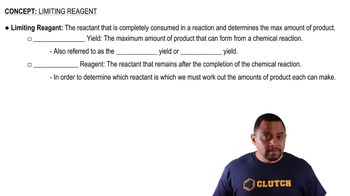
The limiting reactant is the substance that is completely consumed first in a chemical reaction, thus determining the maximum amount of product that can be formed. Identifying the limiting reactant is crucial for calculating the yield of products. In this reaction, the initial amounts of CH₃OH and O₂ will dictate which reactant limits the formation of CO₂.
Video consigliato:
Percorso guidato
01:30
Limiting Reagent Concept

Molecular Diagrams

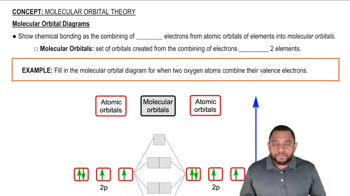
Molecular diagrams visually represent the arrangement and interaction of molecules in a chemical reaction. They help in understanding the initial concentrations of reactants and the potential products formed. Analyzing these diagrams can provide insights into how many molecules of CO₂ can be produced based on the initial mixture of CH₃OH and O₂.
Video consigliato:
Percorso guidato
04:12
Molecular Orbital Diagram
Pratica correlata
Domanda del libro di testo

Calculate the theoretical yield of the product (in moles) for each initial amount of reactants.

Ti(s) + 2 Cl2(g) → TiCl4(s)

a. 4 mol Ti, 4 mol Cl2

b. 7 mol Ti, 17 mol Cl2

c. 12.4 mol Ti, 18.8 mol Cl2

1693
views

Domanda del libro di testo

Calculate the theoretical yield of product (in moles) for each initial amount of reactants.

3 Mn(s) + 2 O2(g) → Mn3O4(s)

a. 3 mol Mn, 2 mol O2

b. 4 mol Mn, 7 mol O2

c. 27.5 mol Mn, 43.8 mol O2

3761
views
1
rank
Domanda del libro di testo

Zinc sulfide reacts with oxygen according to the reaction: 2 ZnS(s) + 3 O2(g) → 2 ZnO(s) + 2 SO2( g) A reaction mixture initially contains 4.2 mol ZnS and 6.8 mol O2. Once the reaction has occurred as completely as possible, what amount (in moles) of the excess reactant remains?

7103
views
1
comments
Domanda del libro di testo

Find the limiting reactant for each initial amount of reactants. 4 Al(s) + 3 O2( g) → 2 Al2O3(s)

a. 1 mol Al, 1 mol O2

b. 4 mol Al, 2.6 mol O2

c. 16 mol Al, 13 mol O2

d. 7.4 mol Al, 6.5 mol O2

3015
views
1
comments
Domanda del libro di testo

Consider the reaction: 4 HCl(g) + O2(g) → 2 H2O(g) + 2 Cl2(g) Each molecular diagram represents an initial mixture of reactants. How many molecules of Cl2 form from the reaction mixture that produces the greatest amount of products?

2250
views
3
rank
Domanda del libro di testo

Find the limiting reactant for each initial amount of reactants.

2 Na(s) + Br2(g) → 2 NaBr(s)

a. 2 mol Na, 2 mol Br2

b. 1.8 mol Na, 1.4 Br2

c. 2.5 mol Na, 1 mol Br2

d. 12.6 mol Na, 6.9 mol Br2

2817
views
1
rank