The mass of an evacuated 255 mL flask is 143.187 g. The mass of the flask filled with 267 torr of an unknown gas at 25 °C is 143.289 g. Calculate the molar mass of the unknown gas.
Ch.5 - Gases
Tro4th EditionChemistry: A Molecular ApproachISBN: 9780134112831Non è quello che usi tu?Cambia libro di testo
Capitolo 5, Problema 99
A gaseous hydrogen- and carbon-containing compound is decomposed and found to contain 82.66% carbon and 17.34% hydrogen by mass. The mass of 158 mL of the gas, measured at 556 mmHg and 25 °C, was 0.275 g. What is the molecular formula of the compound?
Guida verificata passo dopo passo1
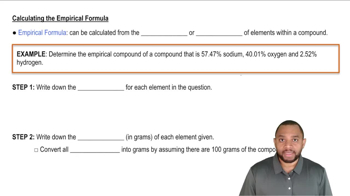
Convert the given percentages of carbon and hydrogen to grams assuming a 100 g sample, which gives 82.66 g of carbon and 17.34 g of hydrogen.
Calculate the number of moles of carbon and hydrogen using their respective molar masses: \( \text{Molar mass of C} = 12.01 \, \text{g/mol} \) and \( \text{Molar mass of H} = 1.008 \, \text{g/mol} \).
Determine the simplest whole number ratio of moles of carbon to moles of hydrogen to find the empirical formula.
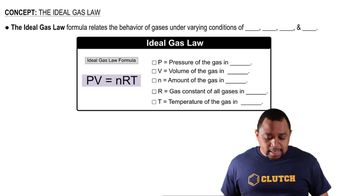
Use the ideal gas law \( PV = nRT \) to calculate the number of moles of the gas, where \( P = 556 \, \text{mmHg} \), \( V = 158 \, \text{mL} \), \( R = 0.0821 \, \text{L} \, \text{atm/mol} \, \text{K} \), and \( T = 25 \, ^\circ\text{C} \).
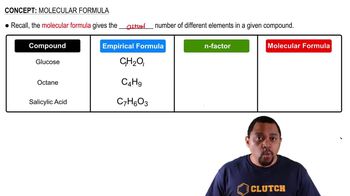
Calculate the molar mass of the compound using the mass of the gas and the moles calculated, then compare it with the empirical formula mass to determine the molecular formula.

Risposta video verificata per un problema simile:
Questa soluzione video è stata consigliata dai nostri tutor come utile per risolvere questo problema.
Durata del video:
8mConcetti chiave
Ecco i concetti essenziali che devi comprendere per rispondere correttamente alla domanda.
Empirical Formula Calculation
The empirical formula represents the simplest whole-number ratio of elements in a compound. To determine it, the mass percentages of each element are converted to moles by dividing by their atomic masses. The resulting mole ratios are then simplified to the smallest whole numbers, providing a foundational understanding of the compound's composition.
Video consigliato:
Percorso guidato
Empirical Formula Calculation Example
Ideal Gas Law
The Ideal Gas Law (PV=nRT) relates the pressure, volume, temperature, and number of moles of a gas. It allows for the calculation of the number of moles from the given conditions of pressure and temperature. Understanding this law is crucial for converting the mass of the gas into moles, which is necessary for determining the molecular formula.
Video consigliato:
Percorso guidato
Ideal Gas Law Formula
Molecular Formula Determination
The molecular formula of a compound indicates the actual number of atoms of each element present in a molecule. It can be derived from the empirical formula by comparing the molar mass of the compound to the molar mass of the empirical formula. This step is essential for identifying the true composition of the compound after calculating the empirical formula.
Video consigliato:
Percorso guidato
Determining Molecular Formulas
Pratica correlata
Domanda del libro di testo
2172
views
2
rank
Domanda del libro di testo
A gaseous hydrogen- and carbon-containing compound is decomposed and found to contain 85.63% C and 14.37% H by mass. The mass of 258 mL of the gas, measured at STP, was 0.646 g. What is the molecular formula of the compound?
2574
views
3
rank
Domanda del libro di testo
Consider the reaction: 2 Ag2O(s) → 4 Ag(s) + O2(g) If this reaction produces 15.8 g of Ag(s), what total volume of gas can be collected over water at a temperature of 25 °C and a total pressure of 752 mmHg?
407
views
Domanda del libro di testo
A 2.85-g sample of an unknown chlorofluorocarbon decomposes and produces 564 mL of chlorine gas at a pressure of 752 mmHg and a temperature of 298 K. What is the percent chlorine (by mass) in the unknown chlorofluorocarbon?
1283
views