
A catalytic converter in an automobile uses a palladium or platinum catalyst (a substance that increases the rate of a reaction without being consumed by the reaction) to convert carbon monoxide gas to carbon dioxide according to the reaction: 2 CO(g) + O2(g) → 2 CO2(g) A chemist researching the effectiveness of a new catalyst combines a 2.0:1.0 mole ratio mixture of carbon monoxide and oxygen gas (respectively) over the catalyst in a 2.45-L flask at a total pressure of 745 torr and a temperature of 552 °C. When the reaction is complete, the pressure in the flask has dropped to 552 torr. What percentage of the carbon monoxide was converted to carbon dioxide?
Ch.5 - Gases
Tro4th EditionChemistry: A Molecular ApproachISBN: 9780134112831Non è quello che usi tu?Cambia libro di testo
Capitolo 5, Problema 115
A scuba diver creates a spherical bubble with a radius of 2.5 cm at a depth of 30.0 m where the total pressure (including atmospheric pressure) is 4.00 atm. What is the radius of the bubble when it reaches the surface of the water? (Assume that the atmospheric pressure is 1.00 atm and the temperature is 298 K.)
Guida verificata passo dopo passo1
Identify the initial and final conditions of the bubble. Initially, the bubble is at a depth of 30.0 m with a total pressure of 4.00 atm and a radius of 2.5 cm. At the surface, the pressure is 1.00 atm.
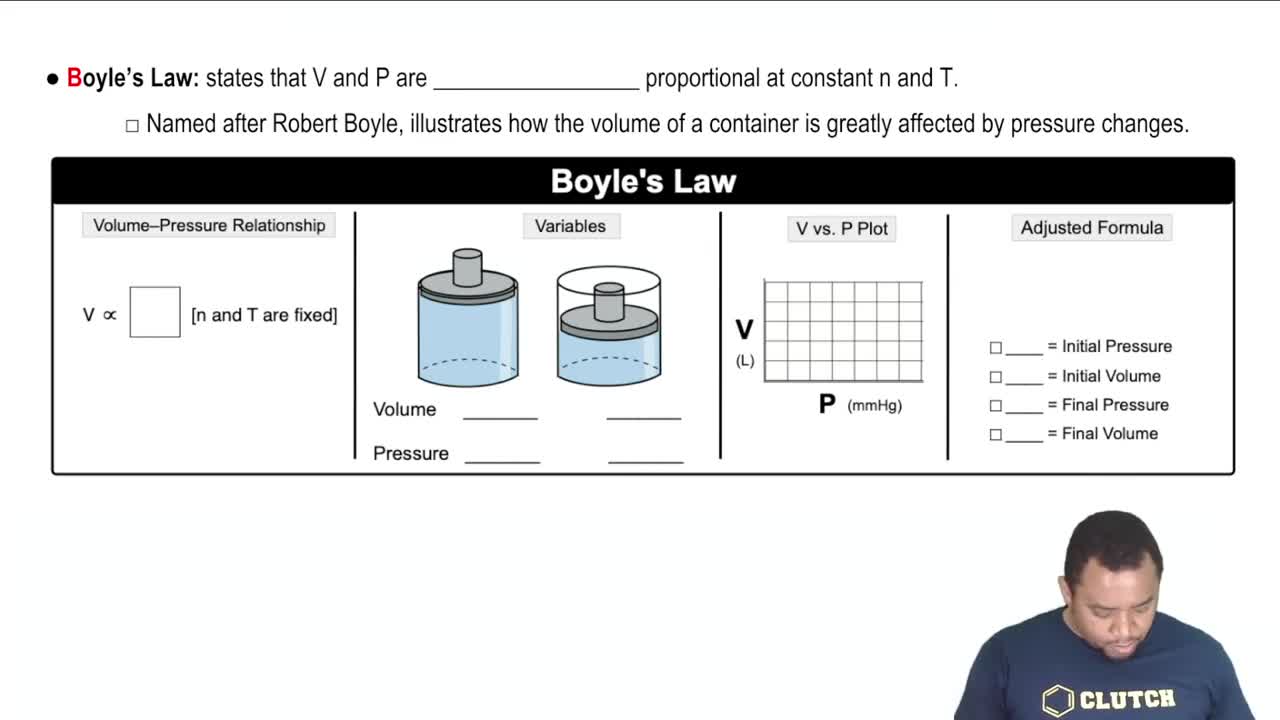
Apply the ideal gas law in the form of Boyle's Law, which states that for a given amount of gas at constant temperature, the product of pressure and volume is constant: \( P_1V_1 = P_2V_2 \).
Calculate the initial volume \( V_1 \) of the bubble using the formula for the volume of a sphere: \( V_1 = \frac{4}{3}\pi r_1^3 \), where \( r_1 = 2.5 \) cm.
Set up the equation using Boyle's Law: \( 4.00 \text{ atm} \times V_1 = 1.00 \text{ atm} \times V_2 \). Solve for \( V_2 \), the volume of the bubble at the surface.
Calculate the final radius \( r_2 \) of the bubble at the surface using the formula for the volume of a sphere: \( V_2 = \frac{4}{3}\pi r_2^3 \). Solve for \( r_2 \).

Risposta video verificata per un problema simile:
Questa soluzione video è stata consigliata dai nostri tutor come utile per risolvere questo problema.
Durata del video:
2mConcetti chiave
Ecco i concetti essenziali che devi comprendere per rispondere correttamente alla domanda.
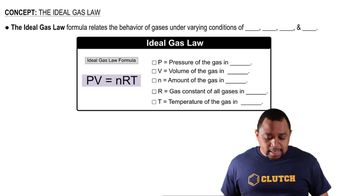
Ideal Gas Law
The Ideal Gas Law relates the pressure, volume, temperature, and number of moles of a gas through the equation PV = nRT. In this scenario, the pressure and volume of the gas bubble change as it ascends, while the temperature remains constant. Understanding this law is crucial for calculating how the volume (and thus the radius) of the bubble changes with pressure.
Video consigliato:
Percorso guidato
Ideal Gas Law Formula
Boyle's Law
Boyle's Law states that the pressure of a gas is inversely proportional to its volume when temperature is held constant (P1V1 = P2V2). This principle is essential for determining how the volume of the bubble will change as the diver ascends and the pressure decreases from 4.00 atm to 1.00 atm, allowing us to find the new radius of the bubble at the surface.
Video consigliato:
Percorso guidato
Boyle's Law
Spherical Geometry
The volume of a sphere is calculated using the formula V = (4/3)πr³, where r is the radius. When the volume of the bubble changes due to pressure changes, the radius can be derived from the new volume. Understanding spherical geometry is necessary to relate the volume of the bubble to its radius, which is the final step in solving the problem.
Video consigliato:
Percorso guidato
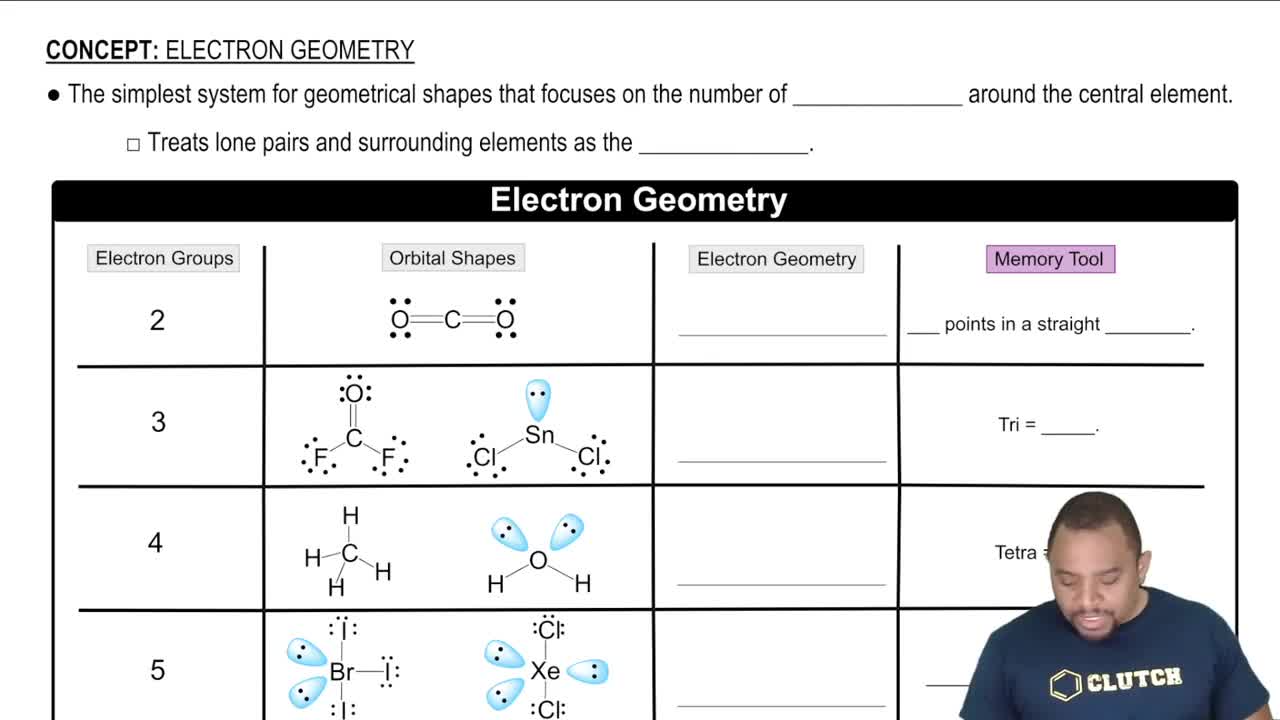
Electron Geometry
Pratica correlata
Domanda del libro di testo
3208
views
Domanda del libro di testo
An 11.5-mL sample of liquid butane (density = 0.573 g/mL) is evaporated in an otherwise empty container at a temperature of 28.5 °C. The pressure in the container following evaporation is 892 torr. What is the volume of the container?
3353
views
3
rank
Domanda del libro di testo
A quantity of N2 occupies a volume of 1.0 L at 300 K and 1.0 atm. The gas expands to a volume of 3.0 L as the result of a change in both temperature and pressure. Find the density of the gas at these new conditions.
1657
views
1
comments
