
Ch.5 - Gases
Tro - Chemistry: A Molecular Approach 4th Edition
Tro4th EditionChemistry: A Molecular ApproachISBN: 9780134112831Non è quello che usi tu?Cambia libro di testo
Capitolo 5, Problema 114

An 11.5-mL sample of liquid butane (density = 0.573 g/mL) is evaporated in an otherwise empty container at a temperature of 28.5 °C. The pressure in the container following evaporation is 892 torr. What is the volume of the container?

Guida verificata passo dopo passo
1
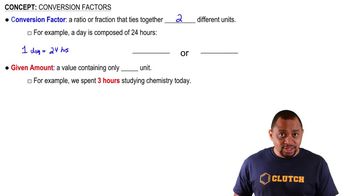
Convert the pressure from torr to atm using the conversion factor: 1 atm = 760 torr.
Calculate the mass of butane using the formula: mass = volume \(\times\) density.
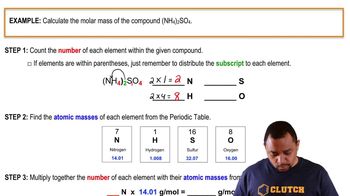
Convert the mass of butane to moles using the molar mass of butane (C_4H_{10}).
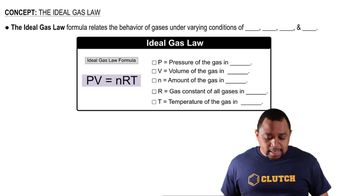
Use the ideal gas law equation, PV = nRT, to solve for the volume of the container (V).
Ensure that the temperature is converted to Kelvin by adding 273.15 to the Celsius temperature before using it in the ideal gas law equation.

Risposta video verificata per un problema simile:

Questa soluzione video è stata consigliata dai nostri tutor come utile per risolvere questo problema.

Concetti chiave

Ecco i concetti essenziali che devi comprendere per rispondere correttamente alla domanda.

Density and Mass Calculation

Density is defined as mass per unit volume, typically expressed in grams per milliliter (g/mL). To find the mass of the liquid butane, you can use the formula: mass = density × volume. In this case, with a density of 0.573 g/mL and a volume of 11.5 mL, the mass can be calculated, which is essential for further calculations involving the gas phase.
Video consigliato:
Percorso guidato
03:12
Molar Mass Calculation Example

Ideal Gas Law

The Ideal Gas Law relates the pressure, volume, temperature, and number of moles of a gas through the equation PV = nRT. Here, P is pressure in atmospheres, V is volume in liters, n is the number of moles, R is the ideal gas constant, and T is temperature in Kelvin. This law is crucial for determining the volume of the container after the butane has evaporated.
Video consigliato:
Percorso guidato
01:15
Ideal Gas Law Formula

Conversion of Units

In chemistry, it is often necessary to convert units to ensure consistency in calculations. For example, pressure may need to be converted from torr to atmospheres, and volume from milliliters to liters. Understanding how to perform these conversions is vital for accurately applying the Ideal Gas Law and obtaining the correct volume of the container.
Video consigliato:
Percorso guidato
01:56
Conversion Factors