Ch.5 - Gases
Tro - Chemistry: A Molecular Approach 4th Edition
Tro4th EditionChemistry: A Molecular ApproachISBN: 9780134112831Non è quello che usi tu?Cambia libro di testo
Capitolo 5, Problema 84

Calculate the root mean square velocity and kinetic energy of CO, CO2, and SO3 at 298 K. Which gas has the greatest velocity? The greatest kinetic energy? The greatest effusion rate?

Guida verificata passo dopo passo
1
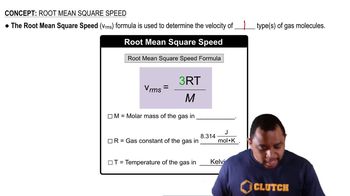
Identify the formula for root mean square velocity: \(v_{rms} = \sqrt{\frac{3RT}{M}}\), where \(R\) is the ideal gas constant, \(T\) is the temperature in Kelvin, and \(M\) is the molar mass in kg/mol.
Convert the molar masses of CO, CO2, and SO3 from g/mol to kg/mol. For CO, it's 28.01 g/mol, for CO2, it's 44.01 g/mol, and for SO3, it's 80.06 g/mol.
Calculate the root mean square velocity for each gas using the formula from step 1, substituting the appropriate molar mass and the given temperature of 298 K.
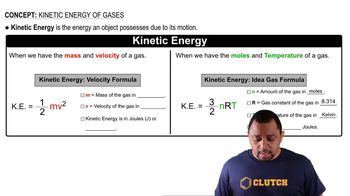
Use the kinetic energy formula \(KE = \frac{1}{2}mv^2\) to compare the kinetic energies of the gases, where \(m\) is the molar mass and \(v\) is the velocity calculated in step 3.
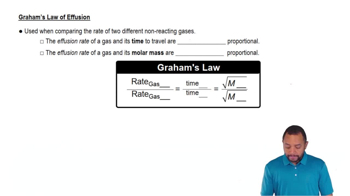
Apply Graham's law of effusion, which states that the rate of effusion is inversely proportional to the square root of the molar mass, to determine which gas has the greatest effusion rate.

Risposta video verificata per un problema simile:

Questa soluzione video è stata consigliata dai nostri tutor come utile per risolvere questo problema.
Durata del video:
3m

Concetti chiave

Ecco i concetti essenziali che devi comprendere per rispondere correttamente alla domanda.

Root Mean Square Velocity

Root mean square (RMS) velocity is a measure of the average speed of gas molecules in a sample. It is calculated using the formula v_rms = sqrt(3RT/M), where R is the ideal gas constant, T is the temperature in Kelvin, and M is the molar mass of the gas in kg/mol. This concept is crucial for comparing the velocities of different gases at the same temperature.
Video consigliato:
Percorso guidato
01:05
Root Mean Square Speed Formula

Kinetic Energy of Gases

The kinetic energy of a gas is related to the motion of its molecules and is given by the formula KE = (1/2)mv^2, where m is the mass of the molecule and v is its velocity. For an ideal gas, the average kinetic energy can also be expressed as KE_avg = (3/2)RT. Understanding this concept helps in determining which gas has the greatest kinetic energy at a given temperature.
Video consigliato:
Percorso guidato
02:27
Kinetic Energy Formulas

Graham's Law of Effusion

Graham's Law states that the rate of effusion of a gas is inversely proportional to the square root of its molar mass. This means lighter gases effuse faster than heavier gases. This principle is essential for determining which gas will effuse more quickly under the same conditions, allowing for comparisons between CO, CO2, and SO3.
Video consigliato:
Percorso guidato
2:03
Graham's Law of Effusion