Ch.5 - Gases
Tro - Chemistry: A Molecular Approach 4th Edition
Tro4th EditionChemistry: A Molecular ApproachISBN: 9780134112831Non è quello che usi tu?Cambia libro di testo
Capitolo 5, Problema 85

We separate U-235 from U-238 by fluorinating a sample of uranium to form UF6 (which is a gas) and then taking advantage of the different rates of effusion and diffusion for compounds containing the two isotopes. Calculate the ratio of effusion rates for 238UF6 and 235UF6. The atomic mass of U-235 is 235.054 amu and that of U-238 is 238.051 amu.

Guida verificata passo dopo passo
1
Identify the formula for effusion rates: Graham's law of effusion states that the rate of effusion of a gas is inversely proportional to the square root of its molar mass. Mathematically, this is expressed as \( \frac{r_1}{r_2} = \sqrt{\frac{M_2}{M_1}} \), where \( r_1 \) and \( r_2 \) are the effusion rates of gases 1 and 2, and \( M_1 \) and \( M_2 \) are their respective molar masses.
Determine the molar masses of \( ^{238}\text{UF}_6 \) and \( ^{235}\text{UF}_6 \): The molar mass of \( ^{238}\text{UF}_6 \) is the sum of the atomic mass of \( ^{238}\text{U} \) and six times the atomic mass of fluorine (\( 18.998 \text{ amu} \)). Similarly, calculate the molar mass for \( ^{235}\text{UF}_6 \).
Calculate the molar mass of \( ^{238}\text{UF}_6 \): \( M_{238} = 238.051 + 6 \times 18.998 \).
Calculate the molar mass of \( ^{235}\text{UF}_6 \): \( M_{235} = 235.054 + 6 \times 18.998 \).
Apply Graham's law to find the ratio of effusion rates: Substitute the molar masses into the formula \( \frac{r_{238}}{r_{235}} = \sqrt{\frac{M_{235}}{M_{238}}} \) to find the ratio of effusion rates for \( ^{238}\text{UF}_6 \) and \( ^{235}\text{UF}_6 \).

Risposta video verificata per un problema simile:

Questa soluzione video è stata consigliata dai nostri tutor come utile per risolvere questo problema.
Durata del video:
1m

Concetti chiave

Ecco i concetti essenziali che devi comprendere per rispondere correttamente alla domanda.

Effusion and Diffusion

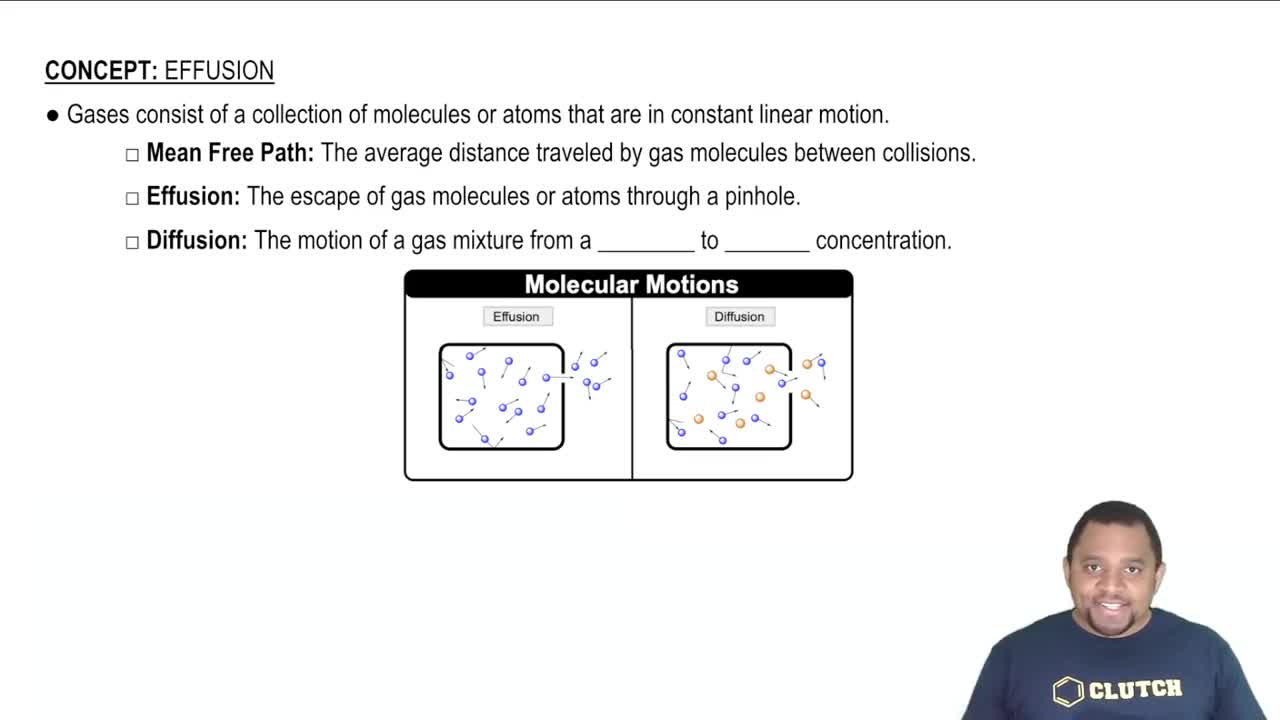
Effusion is the process by which gas molecules escape through a tiny hole into a vacuum, while diffusion is the spreading of gas molecules throughout a space. The rates of these processes depend on the mass of the gas molecules, with lighter molecules effusing and diffusing faster than heavier ones, as described by Graham's law.
Video consigliato:
Percorso guidato
02:33
Effusion vs Diffusion

Graham's Law of Effusion

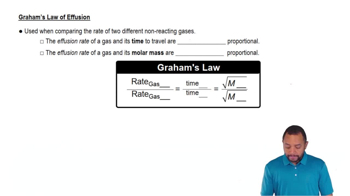
Graham's Law states that the rate of effusion of a gas is inversely proportional to the square root of its molar mass. This means that if two gases have different molar masses, the lighter gas will effuse more quickly than the heavier gas, allowing for the calculation of effusion rates based on their respective masses.
Video consigliato:
Percorso guidato
2:03
Graham's Law of Effusion

Isotopes and Atomic Mass

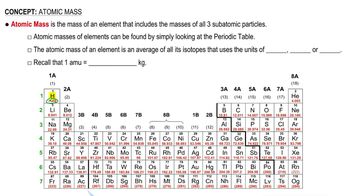
Isotopes are variants of a chemical element that have the same number of protons but different numbers of neutrons, resulting in different atomic masses. In this case, U-235 and U-238 are isotopes of uranium, and their differing atomic masses are crucial for calculating the ratio of their effusion rates, as lighter isotopes will effuse more rapidly.
Video consigliato: