Ch.5 - Gases
Tro - Chemistry: A Molecular Approach 4th Edition
Tro4th EditionChemistry: A Molecular ApproachISBN: 9780134112831Non è quello che usi tu?Cambia libro di testo
Capitolo 5, Problema 104b

Consider the reaction:
2 SO2(g) + O2(g) → 2 SO3(g)
b. If 187.2 mL of SO3 is collected (measured at 315 K and 50.0 mmHg), what is the percent yield for the reaction?

Guida verificata passo dopo passo
1
Identify the balanced chemical equation: 2 SO_2(g) + O_2(g) \(\rightarrow\) 2 SO_3(g).
Use the ideal gas law, PV = nRT, to calculate the moles of SO_3 collected. Convert the pressure from mmHg to atm and the volume from mL to L.
Calculate the theoretical yield of SO_3 in moles using stoichiometry based on the initial amounts of reactants (not provided, but assume you have this information).
Convert the theoretical yield of SO_3 from moles to volume using the ideal gas law, assuming the same conditions of temperature and pressure.
Calculate the percent yield using the formula: \(\text{Percent Yield}\) = \(\left\)( \(\frac{\text{Actual Yield (in moles)}\)}{\(\text{Theoretical Yield (in moles)}\)} \(\right\)) \(\times\) 100.

Risposta video verificata per un problema simile:

Questa soluzione video è stata consigliata dai nostri tutor come utile per risolvere questo problema.
Durata del video:
8m

Concetti chiave

Ecco i concetti essenziali che devi comprendere per rispondere correttamente alla domanda.

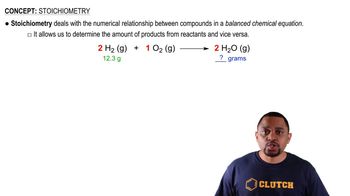
Stoichiometry

Stoichiometry is the calculation of reactants and products in chemical reactions based on the balanced equation. It allows us to determine the theoretical yield of a product from given amounts of reactants. In this case, understanding the stoichiometric ratios of SO2 and O2 to SO3 is essential for calculating the expected yield.
Video consigliato:
Percorso guidato
01:16
Stoichiometry Concept

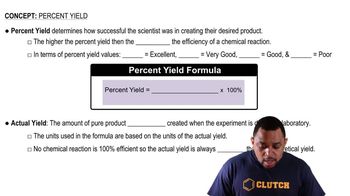
Percent Yield

Percent yield is a measure of the efficiency of a reaction, calculated by comparing the actual yield obtained from an experiment to the theoretical yield predicted by stoichiometry. It is expressed as a percentage and provides insight into how effectively a reaction proceeds under given conditions. The formula is: (actual yield / theoretical yield) × 100.
Video consigliato:
Percorso guidato
03:09
Percent Yield in Reactions

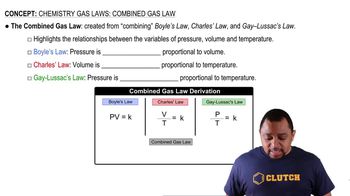
Gas Laws

Gas laws describe the behavior of gases in relation to pressure, volume, and temperature. In this question, the ideal gas law (PV = nRT) can be used to convert the volume of SO3 collected into moles, which is necessary for calculating the percent yield. Understanding how to manipulate these variables is crucial for accurate calculations.
Video consigliato:
Percorso guidato
01:43
Combined Gas Law
Pratica correlata
Domanda del libro di testo

Consider the reaction: 2 Ag2O(s) → 4 Ag(s) + O2(g) If this reaction produces 15.8 g of Ag(s), what total volume of gas can be collected over water at a temperature of 25 °C and a total pressure of 752 mmHg?

407
views

Domanda del libro di testo

Ammonium nitrate decomposes explosively upon heating according to the balanced equation: 2 NH4NO3(s)¡2 N2( g) + O2( g) + 4 H2O( g) Calculate the total volume of gas (at 125 °C and 748 mmHg) produced by the complete decomposition of 1.55 kg of ammonium nitrate.

7866
views
Domanda del libro di testo

Consider the reaction:

2 SO2(g) + O2(g) → 2 SO3(g)

a. If 285.5 mL of SO2 reacts with 158.9 mL of O2 (both measured at 315 K and 50.0 mmHg), what is the limiting reactant and the theoretical yield of SO3?

1301
views
Domanda del libro di testo

Ammonium carbonate decomposes upon heating according to the balanced equation: (NH4)2CO3(s) → 2 NH3(g) + CO2(g) + H2O(g) Calculate the total volume of gas produced at 22 °C and 1.02 atm by the complete decomposition of 11.83 g of ammonium carbonate.

7705
views
Domanda del libro di testo

Olympic cyclists fill their tires with helium to make them lighter. Calculate the mass of air in an air-filled tire and the mass of helium in a helium-filled tire. Assume that the volume of the tire is 855 mL, that it is filled to a total pressure of 125 psi, and that the temperature is 25 °C. Also, assume an average molar mass for air of 28.8 g/mol. Calculate the mass of air in an air-filled tire.

469
views