
Ch.5 - Gases
Tro - Chemistry: A Molecular Approach 4th Edition
Tro4th EditionChemistry: A Molecular ApproachISBN: 9780134112831Non è quello che usi tu?Cambia libro di testo
Capitolo 5, Problema 48

Cyclists sometimes use pressurized carbon dioxide inflators to inflate a bicycle tire in the event of a flat. These inflators use metal cartridges that contain 16.0 g of carbon dioxide. At 298 K, to what pressure (in psi) can the carbon dioxide in the cartridge inflate a 3.45-L mountain bike tire? (Note: Assume that atmospheric pressure is 14.7 psi; the gauge pressure is the total pressure minus the atmospheric pressure.)

Guida verificata passo dopo passo
1
Identify the known values: mass of CO2 = 16.0 g, temperature = 298 K, volume = 3.45 L.
Convert the mass of CO2 to moles using the molar mass of CO2 (44.01 g/mol).
Use the ideal gas law equation, PV = nRT, to solve for the pressure P. Here, R is the ideal gas constant (0.0821 L·atm/mol·K).
Convert the pressure from atm to psi using the conversion factor (1 atm = 14.7 psi).
Calculate the gauge pressure by subtracting the atmospheric pressure (14.7 psi) from the total pressure.

Concetti chiave

Ecco i concetti essenziali che devi comprendere per rispondere correttamente alla domanda.

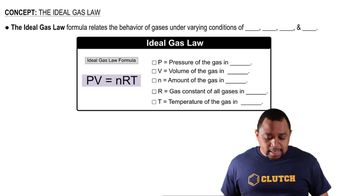
Ideal Gas Law

The Ideal Gas Law relates the pressure, volume, temperature, and number of moles of a gas through the equation PV = nRT. This law is essential for understanding how gases behave under different conditions and allows us to calculate the pressure exerted by the carbon dioxide in the tire when given its mass, volume, and temperature.
Video consigliato:
Percorso guidato
01:15
Ideal Gas Law Formula

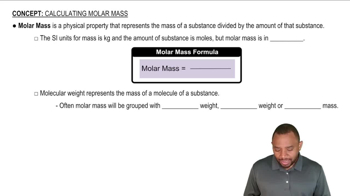
Molar Mass of Carbon Dioxide

The molar mass of carbon dioxide (CO2) is approximately 44.01 g/mol. Knowing the molar mass is crucial for converting the mass of CO2 in the cartridge (16.0 g) into moles, which is necessary for applying the Ideal Gas Law to find the pressure in the tire.
Video consigliato:
Percorso guidato
02:11
Molar Mass Concept

Gauge Pressure

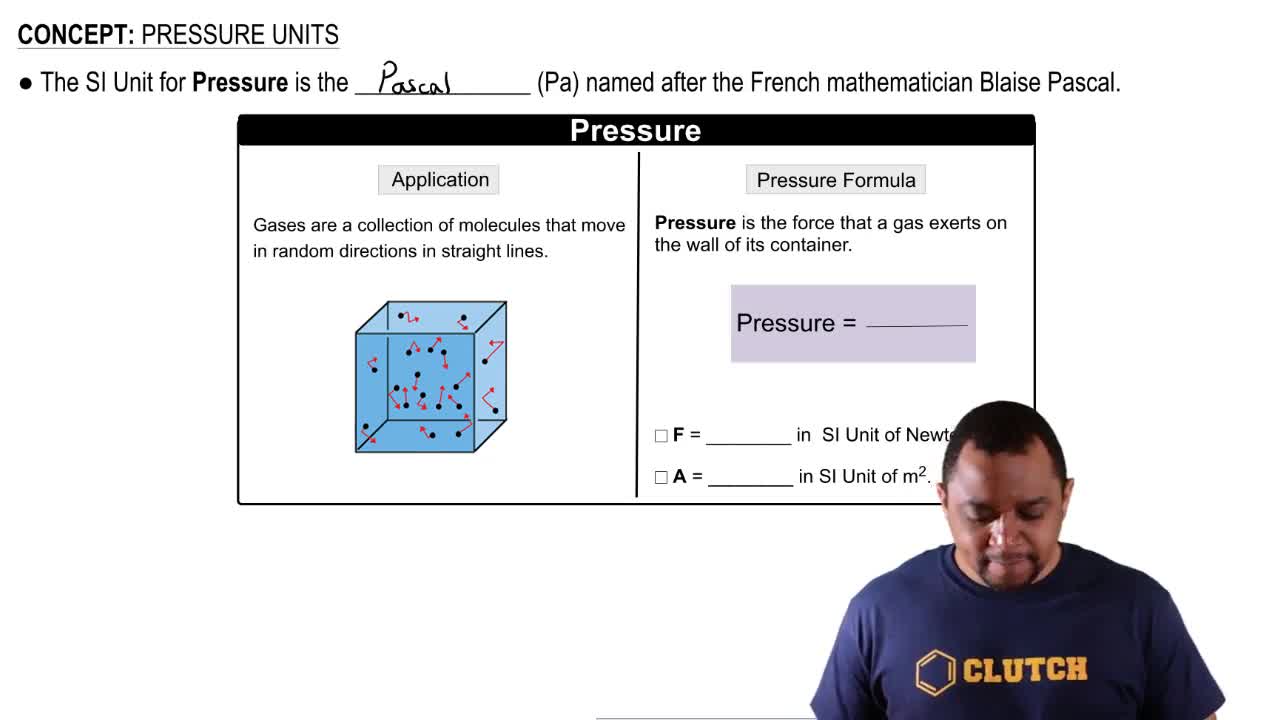
Gauge pressure is the pressure of a system above atmospheric pressure. In this context, it is calculated by subtracting the atmospheric pressure (14.7 psi) from the total pressure of the gas in the tire. Understanding gauge pressure is important for determining how much pressure is available for inflating the tire effectively.
Video consigliato:
Pratica correlata