Ch.5 - Gases
Tro - Chemistry: A Molecular Approach 4th Edition
Tro4th EditionChemistry: A Molecular ApproachISBN: 9780134112831Non è quello che usi tu?Cambia libro di testo
Capitolo 5, Problema 89

The graph shows the distribution of molecular velocities for two different molecules (A and B) at the same temperature. Which molecule has the higher molar mass? Which molecule has the higher rate of effusion?
Graph showing molecular velocity distributions for two molecules at the same temperature.

Guida verificata passo dopo passo
1
Identify the two curves on the graph. The curve with the peak at a lower velocity represents molecule A, and the curve with the peak at a higher velocity represents molecule B.
Recall that at the same temperature, lighter molecules move faster than heavier molecules. Therefore, the molecule with the higher peak velocity (molecule B) has a lower molar mass.
Conversely, the molecule with the lower peak velocity (molecule A) has a higher molar mass.
According to Graham's law of effusion, the rate of effusion of a gas is inversely proportional to the square root of its molar mass. Therefore, the molecule with the lower molar mass (molecule B) will have a higher rate of effusion.
Summarize the findings: Molecule A has the higher molar mass, and molecule B has the higher rate of effusion.

Risposta video verificata per un problema simile:

Questa soluzione video è stata consigliata dai nostri tutor come utile per risolvere questo problema.
Durata del video:
5m

Concetti chiave

Ecco i concetti essenziali che devi comprendere per rispondere correttamente alla domanda.

Molecular Velocity Distribution

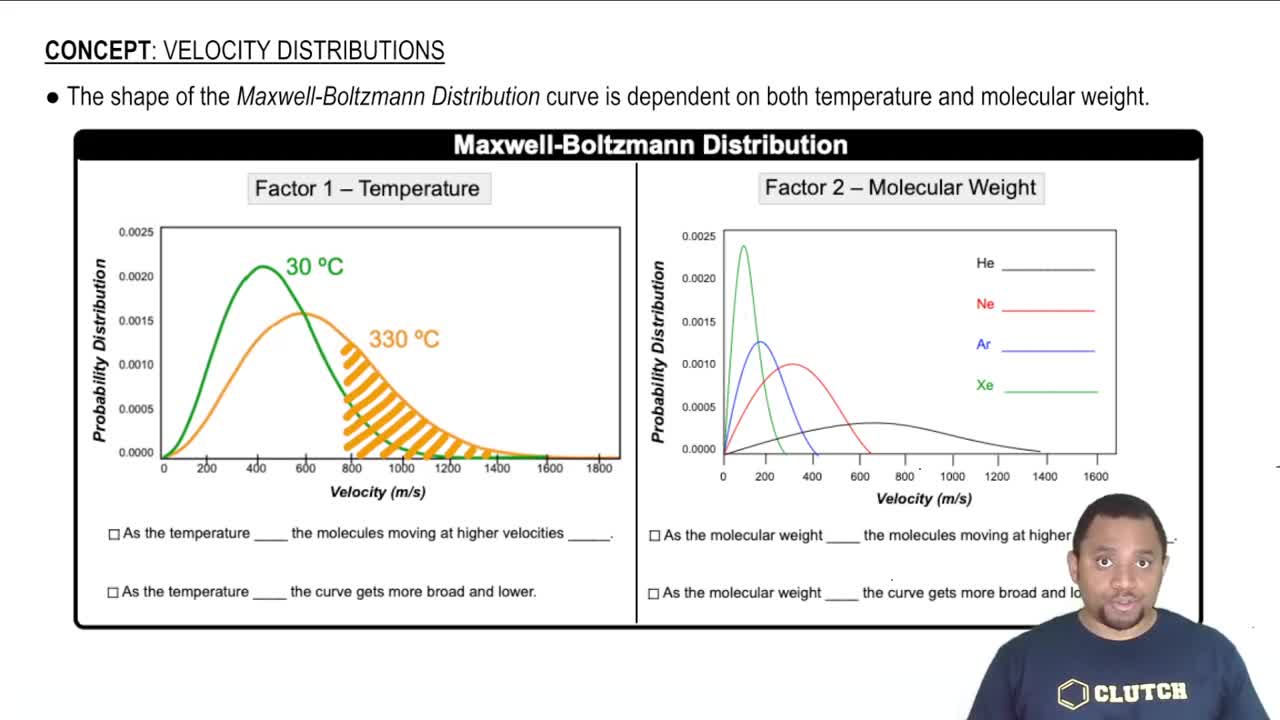
The molecular velocity distribution describes how the speeds of molecules in a gas vary at a given temperature. It is typically represented by a graph showing the number of molecules at different velocities. The shape of the distribution indicates the average speed and the spread of molecular speeds, which is influenced by the mass of the molecules.
Video consigliato:
Percorso guidato
02:47
Velocity Distributions

Graham's Law of Effusion

Graham's Law states that the rate of effusion of a gas is inversely proportional to the square root of its molar mass. This means that lighter molecules effuse faster than heavier ones. In the context of the question, the molecule with the higher average velocity in the distribution graph will have a lower molar mass and thus a higher rate of effusion.
Video consigliato:
Percorso guidato
2:03
Graham's Law of Effusion

Kinetic Molecular Theory

Kinetic Molecular Theory explains the behavior of gases in terms of particle motion. It posits that gas molecules are in constant random motion and that temperature is a measure of the average kinetic energy of these molecules. This theory helps to understand why lighter molecules move faster than heavier ones at the same temperature, affecting their velocity distribution and effusion rates.
Video consigliato:
Percorso guidato
01:19
Kinetic Molecular Theory