
Use the van der Waals equation and the ideal gas equation to calculate the volume of 1.000 mol of neon at a pressure of 500.0 atm and a temperature of 355.0 K. Explain why the two values are different. (Hint: One way to solve the van der Waals equation for V is to use successive approximations. Use the ideal gas law to get a preliminary estimate for V.)
Ch.5 - Gases
Tro4th EditionChemistry: A Molecular ApproachISBN: 9780134112831Non è quello che usi tu?Cambia libro di testo
Capitolo 5, Problema 91
Which postulate of the kinetic molecular theory breaks down under conditions of high pressure? Explain.
Guida verificata passo dopo passo1
Identify the postulates of the kinetic molecular theory, which include: 1) Gas particles are in constant, random motion. 2) The volume of the gas particles is negligible compared to the volume of the container. 3) Gas particles exert no forces on each other; they neither attract nor repel each other. 4) Collisions between gas particles and with the walls of the container are perfectly elastic. 5) The average kinetic energy of gas particles is proportional to the temperature in Kelvin.
Recognize that under high pressure, the volume of the gas particles becomes significant compared to the volume of the container.
Understand that at high pressure, gas particles are much closer together, which means the assumption that gas particles exert no forces on each other (postulate 3) breaks down.
Explain that under these conditions, intermolecular forces become significant, leading to deviations from ideal gas behavior.
Conclude that the postulate stating that gas particles exert no forces on each other is the one that breaks down under high pressure conditions.

Risposta video verificata per un problema simile:
Questa soluzione video è stata consigliata dai nostri tutor come utile per risolvere questo problema.
Durata del video:
45sConcetti chiave
Ecco i concetti essenziali che devi comprendere per rispondere correttamente alla domanda.
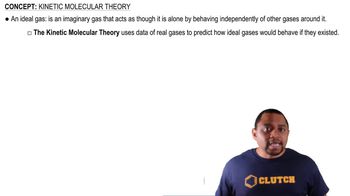
Kinetic Molecular Theory
The Kinetic Molecular Theory (KMT) describes the behavior of gases in terms of particles in constant motion. It posits that gas particles are small, have negligible volume, and experience elastic collisions. This theory helps explain gas properties such as pressure, temperature, and volume, providing a framework for understanding gas behavior under various conditions.
Video consigliato:
Percorso guidato
Kinetic Molecular Theory
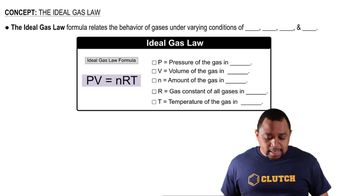
Ideal Gas Behavior
Ideal gas behavior refers to the assumption that gas particles do not interact with each other and occupy no volume. This behavior is described by the Ideal Gas Law (PV=nRT), which holds true under low pressure and high temperature. However, deviations from ideal behavior occur at high pressures, where particle volume and intermolecular forces become significant.
Video consigliato:
Percorso guidato
Ideal Gas Law Formula
High Pressure Effects
Under high pressure, the assumptions of the Kinetic Molecular Theory begin to break down because gas particles are forced closer together, leading to significant intermolecular forces and a noticeable volume of the particles themselves. This results in deviations from the Ideal Gas Law, as real gases do not behave ideally under such conditions, affecting their pressure, volume, and temperature relationships.
Video consigliato:
Percorso guidato
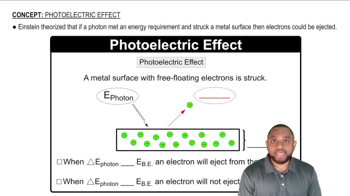
Photoelectric Effect
Pratica correlata
Domanda del libro di testo
3749
views
Domanda del libro di testo
The graph shows the distribution of molecular velocities for the same molecule at two different temperatures (T1 and T2). Which temperature is greater? Explain.
602
views
Domanda del libro di testo
Use the van der Waals equation and the ideal gas equation to calculate the pressure exerted by 1.000 mol of Cl2 in a volume of 5.000 L at a temperature of 273.0 K. Explain why the two values are different.
2396
views
1
rank
Domanda del libro di testo
A sample of N2O effuses from a container in 42 seconds. How long will it take the same amount of gaseous I2 to effuse from the same container under identical conditions?
3361
views
Domanda del libro di testo
The graph shows the distribution of molecular velocities for two different molecules (A and B) at the same temperature. Which molecule has the higher molar mass? Which molecule has the higher rate of effusion?
1584
views
1
rank
