Ch.5 - Gases
Tro - Chemistry: A Molecular Approach 4th Edition
Tro4th EditionChemistry: A Molecular ApproachISBN: 9780134112831Non è quello che usi tu?Cambia libro di testo
Capitolo 5, Problema 67

The hydrogen gas formed in a chemical reaction is collected over water at 30.0 °C at a total pressure of 732 mmHg. What is the partial pressure of the hydrogen gas collected in this way? If the total volume of gas collected is 722 mL, what mass of hydrogen gas is collected?

Guida verificata passo dopo passo
1
Identify the known values: total pressure (P_total) = 732 mmHg, temperature (T) = 30.0 °C, volume (V) = 722 mL.
Convert the temperature from Celsius to Kelvin using the formula: T(K) = T(°C) + 273.15.
Look up the vapor pressure of water at 30.0 °C from a reference table.
Calculate the partial pressure of hydrogen gas (P_H2) using Dalton's Law: P_H2 = P_total - P_water.
Use the ideal gas law, PV = nRT, to find the number of moles of hydrogen gas (n), and then convert moles to mass using the molar mass of hydrogen (H2).

Risposta video verificata per un problema simile:

Questa soluzione video è stata consigliata dai nostri tutor come utile per risolvere questo problema.
Durata del video:
6m

Concetti chiave

Ecco i concetti essenziali che devi comprendere per rispondere correttamente alla domanda.

Dalton's Law of Partial Pressures

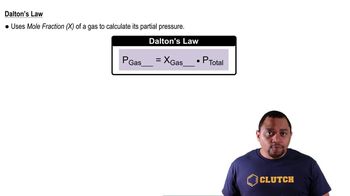
Dalton's Law states that in a mixture of gases, the total pressure exerted is equal to the sum of the partial pressures of each individual gas. In this scenario, the total pressure of the gas collected includes both the hydrogen gas and the water vapor. To find the partial pressure of hydrogen, one must subtract the vapor pressure of water at the given temperature from the total pressure.
Video consigliato:
Percorso guidato
00:27
Dalton's Law and Partial Pressure

Vapor Pressure of Water

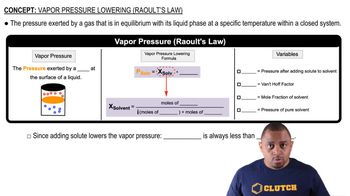
The vapor pressure of water is the pressure exerted by water vapor in equilibrium with its liquid at a specific temperature. At 30.0 °C, the vapor pressure of water is approximately 31.8 mmHg. This value is crucial for calculating the partial pressure of hydrogen gas, as it must be deducted from the total pressure to isolate the pressure of the hydrogen collected.
Video consigliato:
Percorso guidato
02:40
Raoult's Law and Vapor Pressure

Ideal Gas Law

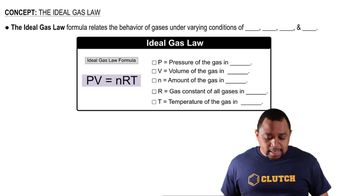
The Ideal Gas Law, represented as PV = nRT, relates the pressure (P), volume (V), number of moles (n), the ideal gas constant (R), and temperature (T) of a gas. This law can be used to calculate the number of moles of hydrogen gas collected from the volume and partial pressure, which can then be converted to mass using the molar mass of hydrogen (2.02 g/mol).
Video consigliato:
Percorso guidato
01:15
Ideal Gas Law Formula
Pratica correlata
Domanda del libro di testo

A gas mixture contains 1.25 g N2 and 0.85 g O2 in a 1.55 L container at 18 °C. Calculate the mole fraction and partial pressure of each component in the gas mixture.

2513
views
1
rank

Domanda del libro di testo

A 275-mL flask contains pure helium at a pressure of 752 torr. A second flask with a volume of 475 mL contains pure argon at a pressure of 722 torr. If we connect the two flasks through a stopcock and we open the stopcock, what is the partial pressure of argon?

3192
views
Domanda del libro di testo

A heliox deep-sea diving mixture contains 2.0 g of oxygen to every 98.0 g of helium. What is the partial pressure of oxygen when this mixture is delivered at a total pressure of 8.5 atm?

3290
views
Domanda del libro di testo

The zinc in a copper-plated penny will dissolve in hydrochloric acid if the copper coating is filed down in several spots (so that the hydrochloric acid can get to the zinc). The reaction between the acid and the zinc is 2 H+(aq) + Zn(s) → H2(g) + Zn2+(aq). When the zinc in a certain penny dissolves, the total volume of gas collected over water at 25 °C is 0.951 L at a total pressure of 748 mmHg. What mass of hydrogen gas is collected?

3332
views
Domanda del libro di testo

What is the mole fraction of oxygen gas in air (see Table 5.3)? What volume of air contains 10.0 g of oxygen gas at 273 K and 1.00 atm?

2667
views
1
rank
1
comments
Domanda del libro di testo

The air in a bicycle tire is bubbled through water and collected at 25 °C. If the total volume of gas collected is 5.45 L at a temperature of 25 °C and a pressure of 745 torr, how many moles of gas were in the bicycle tire?

1692
views