Ch.5 - Gases
Tro - Chemistry: A Molecular Approach 4th Edition
Tro4th EditionChemistry: A Molecular ApproachISBN: 9780134112831Non è quello che usi tu?Cambia libro di testo
Capitolo 5, Problema 94

Use the van der Waals equation and the ideal gas equation to calculate the pressure exerted by 1.000 mol of Cl2 in a volume of 5.000 L at a temperature of 273.0 K. Explain why the two values are different.

Guida verificata passo dopo passo
1
Identify the given values: n = 1.000 mol, V = 5.000 L, T = 273.0 K, and use the van der Waals constants for Cl2: a = 6.49 L^2 atm/mol^2, b = 0.0562 L/mol.
Use the ideal gas law equation: PV = nRT, where R = 0.0821 L atm/mol K. Substitute the given values to calculate the pressure P.
Use the van der Waals equation: \((P + \frac{an^2}{V^2})(V - nb) = nRT\). Substitute the given values and solve for the pressure P.
Compare the pressures obtained from the ideal gas law and the van der Waals equation. Note that the van der Waals equation accounts for intermolecular forces and the volume occupied by gas molecules, which the ideal gas law does not.
Explain that the difference in calculated pressures arises because the ideal gas law assumes no intermolecular forces and that gas molecules have no volume, while the van der Waals equation provides a more accurate representation by considering these factors.

Risposta video verificata per un problema simile:

Questa soluzione video è stata consigliata dai nostri tutor come utile per risolvere questo problema.
Durata del video:
7m

Concetti chiave

Ecco i concetti essenziali che devi comprendere per rispondere correttamente alla domanda.

Ideal Gas Law

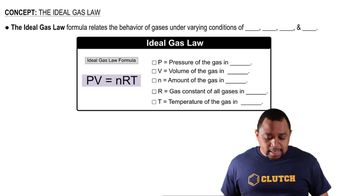
The Ideal Gas Law is a fundamental equation in chemistry, represented as PV = nRT, where P is pressure, V is volume, n is the number of moles, R is the ideal gas constant, and T is temperature in Kelvin. It assumes that gas particles do not interact and occupy no volume, making it a good approximation for gases under low pressure and high temperature.
Video consigliato:
Percorso guidato
01:15
Ideal Gas Law Formula

van der Waals Equation

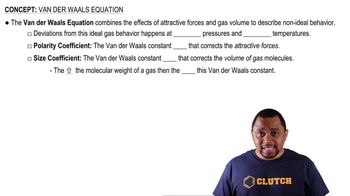
The van der Waals equation is an adjustment of the Ideal Gas Law that accounts for the volume occupied by gas particles and the attractive forces between them. It is expressed as (P + a(n/V)²)(V - nb) = nRT, where 'a' and 'b' are constants specific to each gas. This equation provides a more accurate description of real gas behavior, especially under high pressure and low temperature.
Video consigliato:
Percorso guidato
01:40
Van der Waals Equation

Real vs. Ideal Gases

Real gases deviate from ideal behavior due to intermolecular forces and the finite volume of gas particles. At high pressures and low temperatures, these deviations become significant, leading to differences in calculated pressure using the Ideal Gas Law versus the van der Waals equation. Understanding these differences is crucial for accurately predicting gas behavior in various conditions.
Video consigliato:
Percorso guidato
01:15
Ideal Gas Law Formula
Pratica correlata
Domanda del libro di testo

The mass of an evacuated 255 mL flask is 143.187 g. The mass of the flask filled with 267 torr of an unknown gas at 25 °C is 143.289 g. Calculate the molar mass of the unknown gas.

2172
views
2
rank

Domanda del libro di testo

Which postulate of the kinetic molecular theory breaks down under conditions of high pressure? Explain.

1232
views
Domanda del libro di testo

Use the van der Waals equation and the ideal gas equation to calculate the volume of 1.000 mol of neon at a pressure of 500.0 atm and a temperature of 355.0 K. Explain why the two values are different. (Hint: One way to solve the van der Waals equation for V is to use successive approximations. Use the ideal gas law to get a preliminary estimate for V.)

3749
views
Domanda del libro di testo

A 2.85-g sample of an unknown chlorofluorocarbon decomposes and produces 564 mL of chlorine gas at a pressure of 752 mmHg and a temperature of 298 K. What is the percent chlorine (by mass) in the unknown chlorofluorocarbon?

1283
views
Domanda del libro di testo

Modern pennies are composed of zinc coated with copper. A student determines the mass of a penny to be 2.482 g and then makes several scratches in the copper coating (to expose the underlying zinc). The student puts the scratched penny in hydrochloric acid, where the following reaction occurs between the zinc and the HCl (the copper remains undissolved): Zn(s) + 2 HCl(aq)¡ H2( g) + ZnCl2(aq) The student collects the hydrogen produced over water at 25 °C. The collected gas occupies a volume of 0.899 L at a total pressure of 791 mmHg. Calculate the percent zinc (by mass) in the penny. (Assume that all the Zn in the penny dissolves.)

1611
views
1
comments