
Ch.6 - Thermochemistry
Tro - Chemistry: A Molecular Approach 4th Edition
Tro4th EditionChemistry: A Molecular ApproachISBN: 9780134112831Non è quello che usi tu?Cambia libro di testo
Capitolo 6, Problema 59

Consider the thermochemical equation for the combustion of acetone (C3H6O), the main ingredient in nail polish remover: C3H6O(l) + 4 O2(g) → 3 CO2(g) + 3 H2O(g) ΔH°rxn = -1790 kJ. If a bottle of nail polish remover contains 177 mL of acetone, how much heat is released by its complete combustion? The density of acetone is 0.788 g/mL.

Guida verificata passo dopo passo
1
Calculate the mass of acetone using its volume and density: mass = volume \(\times\) density.
Convert the mass of acetone to moles using its molar mass: moles = \(\frac{mass}{molar\ mass}\).
Use the stoichiometry of the reaction to determine the heat released: \(\Delta\) H_{rxn} is given per mole of acetone.
Multiply the moles of acetone by the \(\Delta\) H_{rxn} to find the total heat released.
Ensure the units are consistent and the final answer is in kilojoules (kJ).

Concetti chiave

Ecco i concetti essenziali che devi comprendere per rispondere correttamente alla domanda.

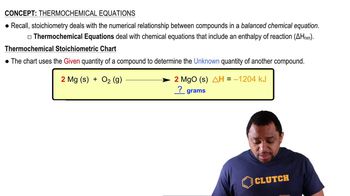
Thermochemical Equations

Thermochemical equations represent the heat changes associated with chemical reactions. They include the enthalpy change (ΔH) which indicates whether a reaction is exothermic (releases heat) or endothermic (absorbs heat). In this case, the negative ΔH°rxn value of -1790 kJ signifies that the combustion of acetone releases 1790 kJ of energy per mole of acetone reacted.
Video consigliato:
Percorso guidato
01:13
Thermochemical Equations

Density and Volume Relationship

Density is defined as mass per unit volume and is crucial for converting between the volume of a liquid and its mass. In this problem, the density of acetone (0.788 g/mL) allows us to calculate the mass of acetone in the bottle by multiplying the volume (177 mL) by the density, which is essential for determining how many moles of acetone are present for the combustion reaction.
Video consigliato:
Percorso guidato
01:09
Relationship of Volume and Moles Example

Mole Concept and Stoichiometry

The mole concept is fundamental in chemistry for quantifying substances. Stoichiometry uses balanced chemical equations to relate the amounts of reactants and products. By calculating the number of moles of acetone from its mass, we can use the stoichiometric coefficients from the thermochemical equation to find the total heat released during its complete combustion.
Video consigliato:
Pratica correlata
Domanda del libro di testo

Determine whether each process is exothermic or endothermic and indicate the sign of ΔH. a. natural gas burning on a stove b. isopropyl alcohol evaporating from skin c. water condensing from steam Indicate the sign of ΔH for the following processes.

549
views
Domanda del libro di testo

Determine whether each process is exothermic or endothermic and indicate the sign of ΔH. a. natural gas burning on a stove b. isopropyl alcohol evaporating from skin c. water condensing from steam Determine whether each of the following is exothermic or endothermic.

1231
views
Domanda del libro di testo

Nitromethane (CH3NO2) burns in air to produce significant amounts of heat. 2 CH3NO2(l) + 3/2 O2(g) → 2 CO2(g) + 3 H2O(l) + N2(g) ΔH°rxn = –1418 kJ How much heat is produced by the complete reaction of 5.56 kg of nitromethane?

2922
views
Domanda del libro di testo

Titanium reacts with iodine to form titanium(III) iodide, emitting heat. 2 Ti(s) + 3 I2(g) → 2 TiI3(s) ΔH°rxn = –839 kJ Determine the mass of titanium that react if 1.55×10³ kJ of heat is emitted by the reaction.

1684
views
Domanda del libro di testo

Determine whether each process is exothermic or endothermic and indicate the sign of ΔH. a. dry ice evaporating b. a sparkler burning c. the reaction that occurs in a chemical cold pack used to ice athletic injuries

579
views
Domanda del libro di testo

What mass of natural gas (CH4) must burn to emit 267 kJ of heat? CH4(g) + 2 O2(g) → CO2(g) + 2 H2O(g) ΔH°rxn = –802.3 kJ

4216
views
2
comments