
Two substances, A and B, initially at different temperatures, come into contact and reach thermal equilibrium. The mass of substance A is 6.15 g and its initial temperature is 20.5 °C. The mass of substance B is 25.2 g and its initial temperature is 52.7 °C. The final temperature of both substances at thermal equilibrium is 46.7 °C. If the specific heat capacity of substance B is 1.17 J/g•°C, what is the specific heat capacity of substance A?
Exactly 1.5 g of a fuel burns under conditions of constant pressure and then again under conditions of constant volume. In measurement A the reaction produces 25.9 kJ of heat, and in measurement B the reaction produces 23.3 kJ of heat. Which measurement (A or B) corresponds to conditions of constant pressure? Explain.
Guida verificata passo dopo passo
Risposta video verificata per un problema simile:
Concetti chiave
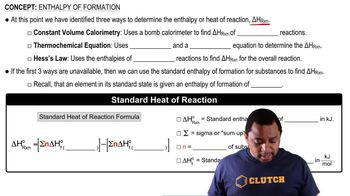
Enthalpy and Heat Transfer
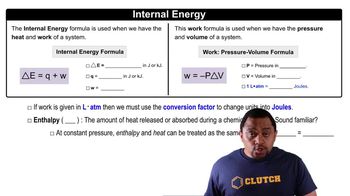
Internal Energy and Work
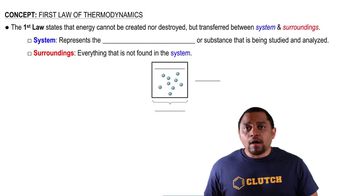
First Law of Thermodynamics
When 0.514 g of biphenyl (C12H10) undergoes combustion in a bomb calorimeter, the temperature rises from 25.8 °C to 29.4 °C. Find ΔErxn for the combustion of biphenyl in kJ/mol biphenyl. The heat capacity of the bomb calorimeter, determined in a separate experiment, is 5.86 kJ/°C.
A 2.85-g lead weight, initially at 10.3 °C, is submerged in 7.55 g of water at 52.3 °C in an insulated container. What is the final temperature of both substances at thermal equilibrium?
A 31.1-g wafer of pure gold, initially at 69.3 °C, is submerged into 64.2 g of water at 27.8 °C in an insulated container. What is the final temperature of both substances at thermal equilibrium?
Mothballs are composed primarily of the hydrocarbon naphthalene (C10H8). When 1.025 g of naphthalene burns in a bomb calorimeter, the temperature rises from 24.25 °C to 32.33 °C. Find ΔErxn for the combustion of naphthalene. The heat capacity of the bomb calorimeter, determined in a separate experiment, is 5.11 kJ/°C.
