
Ch.7 - Quantum-Mechanical Model of the Atom
Tro - Chemistry: A Molecular Approach 4th Edition
Tro4th EditionChemistry: A Molecular ApproachISBN: 9780134112831Non è quello che usi tu?Cambia libro di testo
Capitolo 7, Problema 73

Ultraviolet radiation and radiation of shorter wavelengths can damage biological molecules because these kinds of radiation carry enough energy to break bonds within the molecules. A typical carbon–carbon bond requires 348 kJ/mol to break. What is the longest wavelength of radiation with enough energy to break carbon–carbon bonds?

Guida verificata passo dopo passo
1
Identify the energy required to break a carbon-carbon bond, which is given as 348 kJ/mol.
Convert the energy from kJ/mol to J/photon. Use the conversion factor: 1 kJ = 1000 J and Avogadro's number (6.022 x 10^23 mol^-1) to find the energy per photon.
Use the equation E = h\(\nu\), where E is the energy per photon, h is Planck's constant (6.626 x 10^-34 J·s), and \(\nu\) is the frequency of the radiation. Rearrange the equation to solve for \(\nu\): \(\nu\) = E/h.
Use the relationship between frequency and wavelength: c = \(\lambda\)\(\nu\), where c is the speed of light (3.00 x 10^8 m/s) and \(\lambda\) is the wavelength. Rearrange to solve for \(\lambda\): \(\lambda\) = c/\(\nu\).
Calculate the longest wavelength \(\lambda\) using the values obtained from the previous steps. This wavelength corresponds to the minimum energy required to break the carbon-carbon bond.

Risposta video verificata per un problema simile:

Questa soluzione video è stata consigliata dai nostri tutor come utile per risolvere questo problema.

Concetti chiave

Ecco i concetti essenziali che devi comprendere per rispondere correttamente alla domanda.

Energy and Wavelength Relationship

The energy of electromagnetic radiation is inversely related to its wavelength, described by the equation E = hc/λ, where E is energy, h is Planck's constant, c is the speed of light, and λ is the wavelength. This means that shorter wavelengths correspond to higher energy, which is crucial for understanding how radiation can break chemical bonds.
Video consigliato:
Percorso guidato
00:31
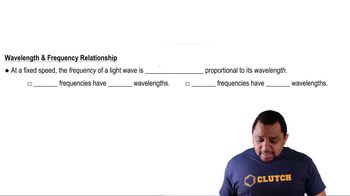
Frequency-Wavelength Relationship

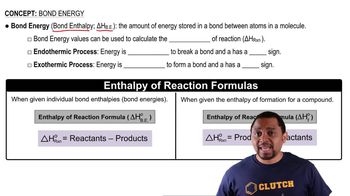
Bond Energy

Bond energy is the amount of energy required to break a bond between two atoms. For carbon–carbon bonds, this energy is approximately 348 kJ/mol. Understanding bond energy is essential for determining the minimum energy required for radiation to effectively break these bonds.
Video consigliato:

Calculating Wavelength from Energy

To find the longest wavelength of radiation that can break a carbon–carbon bond, one can rearrange the energy-wavelength relationship equation to λ = hc/E. By substituting the bond energy into this equation, one can calculate the corresponding wavelength, which indicates the threshold for bond-breaking radiation.
Video consigliato:
Percorso guidato
00:31
Frequency-Wavelength Relationship
Pratica correlata
Domanda del libro di testo

The human eye contains a molecule called 11-cis-retinal that changes shape when struck with light of sufficient energy. The change in shape triggers a series of events that results in an electrical signal being sent to the brain that results in vision. The minimum energy required to change the conformation of 11-cis-retinal within the eye is about 164 kJ/mol. Calculate the longest wavelength visible to the human eye.

5687
views
2
comments
Domanda del libro di testo

An electron in the n = 7 level of the hydrogen atom relaxes to a lower-energy level, emitting light of 397 nm. What is the value of n for the level to which the electron relaxed?

8549
views
5
rank
2
comments
Domanda del libro di testo

An argon ion laser puts out 5.0 W of continuous power at a wavelength of 532 nm. The diameter of the laser beam is 5.5 mm. If the laser is pointed toward a pinhole with a diameter of 1.2 mm, how many photons travel through the pinhole per second? Assume that the light intensity is equally distributed throughout the entire cross-sectional area of the beam. (1 W = 1 J/s)

1009
views
Domanda del libro di testo

Calculate the frequency of the light emitted when an electron in a hydrogen atom makes each transition: a. n = 4 → n = 3 b. n = 5 → n = 1 c. n = 5 → n = 4 d. n = 6 → n = 5

8404
views
1
rank
Domanda del libro di testo

An electron in a hydrogen atom relaxes to the n = 4 level, emitting light of 114 THz. What is the value of n for the level in which the electron originated?

4997
views
2
rank
2
comments