Ch.8 - Periodic Properties of the Elements
Tro - Chemistry: A Molecular Approach 4th Edition
Tro4th EditionChemistry: A Molecular ApproachISBN: 9780134112831Non è quello che usi tu?Cambia libro di testo
Capitolo 8, Problema 77

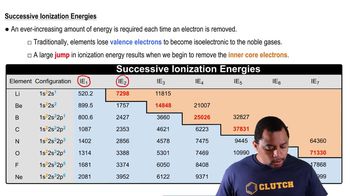
For each element, predict where the 'jump' occurs for successive ionization energies. (For example, does the jump occur between the first and second ionization energies, the second and third, or the third and fourth?) a. Be b. N c. O d. Li

Guida verificata passo dopo passo
1
Identify the electron configuration of each element to understand the distribution of electrons in their atomic orbitals.
Determine the number of valence electrons for each element, as the 'jump' in ionization energy typically occurs after all valence electrons have been removed.
For beryllium (Be), note that it has 2 valence electrons in the 2s orbital, so the jump occurs between the second and third ionization energies.
For nitrogen (N), it has 5 valence electrons in the 2s and 2p orbitals, so the jump occurs between the fifth and sixth ionization energies.
For oxygen (O), it has 6 valence electrons in the 2s and 2p orbitals, so the jump occurs between the sixth and seventh ionization energies.

Risposta video verificata per un problema simile:

Questa soluzione video è stata consigliata dai nostri tutor come utile per risolvere questo problema.
Durata del video:
1m

Concetti chiave

Ecco i concetti essenziali che devi comprendere per rispondere correttamente alla domanda.

Ionization Energy

Ionization energy is the energy required to remove an electron from an atom or ion in its gaseous state. It is a key concept in understanding how easily an atom can lose electrons, which is crucial for predicting chemical reactivity and the formation of ions. Generally, ionization energy increases across a period due to increasing nuclear charge and decreases down a group due to increased electron shielding.
Video consigliato:
Percorso guidato
01:19
Ionization Energy

Successive Ionization Energies

Successive ionization energies refer to the energies required to remove additional electrons from an atom after the first has been removed. Each subsequent ionization energy is typically higher than the previous one due to the increasing positive charge of the ion, which holds the remaining electrons more tightly. However, a significant jump in ionization energy indicates the removal of an electron from a more stable electron configuration, such as moving from a filled shell to a partially filled one.
Video consigliato:
Percorso guidato
02:22
Successive Ionization Energies

Electron Configuration

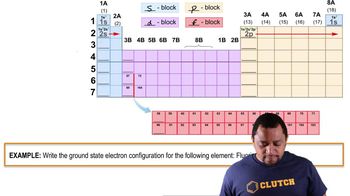
Electron configuration describes the distribution of electrons in an atom's orbitals. Understanding the electron configuration of an element helps predict where jumps in ionization energy will occur, as elements with stable configurations (like noble gases) will show larger jumps when an electron is removed from a filled shell. For example, elements like Li and Be will show a jump between their first and second ionization energies due to the removal of electrons from different energy levels.
Video consigliato:
Percorso guidato
01:33
Electron Configuration Example