Ch.1 - Matter, Measurement & Problem Solving
Tro - Chemistry: A Molecular Approach 5th Edition
Tro5th EditionChemistry: A Molecular ApproachISBN: 9780134874371Non è quello che usi tu?Cambia libro di testo
Capitolo 1, Problema 116

The proton has a radius of approximately 1.0×10⁻¹³ cm and a mass of 1.7×10⁻²⁴ g. Determine the density of a proton for a sphere V = (4/3)πr3.

Guida verificata passo dopo passo
1
Step 1: Identify the given values. The radius (r) of the proton is 1.0 * 10^-13 cm and the mass (m) is 1.7 * 10^-24 g. The formula for the volume (V) of a sphere is (4/3)πr^3.
Step 2: Substitute the given radius into the volume formula. This will give you the volume of the proton in cubic centimeters (cm^3).
Step 3: The density (D) of an object is calculated by dividing its mass by its volume. The formula for density is D = m/V.
Step 4: Substitute the given mass and the calculated volume into the density formula. This will give you the density of the proton in grams per cubic centimeter (g/cm^3).
Step 5: Make sure to check your units and that they are consistent throughout the problem. The final answer should be in g/cm^3.

Risposta video verificata per un problema simile:

Questa soluzione video è stata consigliata dai nostri tutor come utile per risolvere questo problema.
Durata del video:
5m

Concetti chiave

Ecco i concetti essenziali che devi comprendere per rispondere correttamente alla domanda.

Density

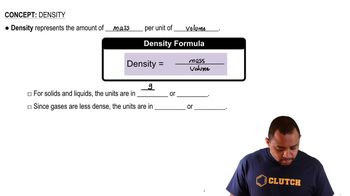
Density is defined as mass per unit volume, typically expressed in grams per cubic centimeter (g/cm³). It provides a measure of how much matter is contained in a given volume. To calculate density, one can use the formula: Density = Mass / Volume, which is essential for determining the density of a proton in this context.
Video consigliato:
Percorso guidato
01:56
Density Concepts

Volume of a Sphere

The volume of a sphere is calculated using the formula V = (4/3)πr³, where r is the radius of the sphere. This formula is crucial for determining the volume of the proton, which is modeled as a sphere for the purpose of this calculation. Understanding how to apply this formula is necessary to find the volume needed for the density calculation.
Video consigliato:
Percorso guidato
02:35
Constant-Volume Calorimetry

Proton Properties

A proton is a subatomic particle found in the nucleus of an atom, characterized by its positive charge and specific mass and radius. In this question, the proton's mass (1.7 * 10^-24 g) and radius (1.0 * 10^-13 cm) are provided, which are essential for calculating its density. Familiarity with these properties helps in understanding the scale and significance of the calculations involved.
Video consigliato:
Percorso guidato
01:38
Neutron-to-Proton Plot