The lattice energy of CsF is -744 kJ/mol, whereas that of BaO is -3029 kJ/mol. Explain this large difference in lattice energy.
Ch.10 - Chemical Bonding I: The Lewis Model
Tro5th EditionChemistry: A Molecular ApproachISBN: 9780134874371Non è quello che usi tu?Cambia libro di testo
Capitolo 10, Problema 47
Use the Born–Haber cycle and data from Appendix IIB, Chapter 9 and this chapter to calculate the lattice energy of KCl. (ΔHsub for potassium is 89.0 kJ>mol.)
Guida verificata passo dopo passo1
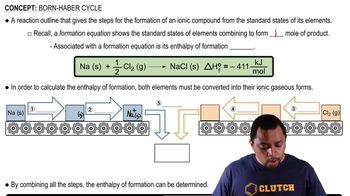
Identify the steps involved in the Born–Haber cycle for KCl, which include sublimation of potassium, ionization of potassium, dissociation of chlorine, electron affinity of chlorine, and formation of KCl from gaseous ions.
Write the equation for the sublimation of potassium: \( \text{K(s)} \rightarrow \text{K(g)} \) with \( \Delta H_{\text{sub}} = 89.0 \text{ kJ/mol} \).
Write the equation for the ionization of gaseous potassium: \( \text{K(g)} \rightarrow \text{K}^+(g) + e^- \) and use the ionization energy from the appendix.
Write the equation for the dissociation of chlorine gas: \( \frac{1}{2} \text{Cl}_2(g) \rightarrow \text{Cl}(g) \) and use the bond dissociation energy from the appendix.
Write the equation for the electron affinity of chlorine: \( \text{Cl}(g) + e^- \rightarrow \text{Cl}^-(g) \) and use the electron affinity value from the appendix.

Risposta video verificata per un problema simile:
Questa soluzione video è stata consigliata dai nostri tutor come utile per risolvere questo problema.
Durata del video:
3mConcetti chiave
Ecco i concetti essenziali che devi comprendere per rispondere correttamente alla domanda.
Born-Haber Cycle
The Born-Haber cycle is a thermodynamic cycle that relates the lattice energy of an ionic compound to other thermodynamic quantities. It involves several steps, including the sublimation of the metal, ionization energy, electron affinity, and the formation of the ionic solid from gaseous ions. This cycle allows for the calculation of lattice energy by applying Hess's law, which states that the total enthalpy change is the sum of the changes in each step.
Video consigliato:
Percorso guidato
Born Haber Cycle
Lattice Energy
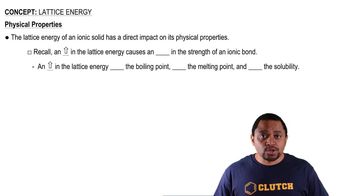
Lattice energy is the energy released when gaseous ions combine to form an ionic solid. It is a measure of the strength of the forces between the ions in the solid lattice structure. A higher lattice energy indicates a more stable ionic compound, as it reflects stronger ionic bonds. Lattice energy can be calculated using the Born-Haber cycle, which incorporates various energy changes associated with the formation of the ionic compound.
Video consigliato:
Percorso guidato
Lattice Energy
Thermodynamic Data
Thermodynamic data, such as enthalpy of sublimation, ionization energy, and electron affinity, are essential for performing calculations in the Born-Haber cycle. These values provide the necessary energy changes that occur during the formation of ionic compounds. For example, the enthalpy of sublimation for potassium (ΔHsub) indicates the energy required to convert solid potassium into gaseous atoms, which is a crucial step in determining the lattice energy of KCl.
Video consigliato:
Percorso guidato
First Law of Thermodynamics
Pratica correlata
Domanda del libro di testo
2194
views
Domanda del libro di testo
Use Lewis symbols to determine the formula for the compound that forms between each pair of elements. a. Ca and N b. Mg and I c. Ca and S d. Cs and F
1733
views
Domanda del libro di testo
Write the Lewis structure for each molecule. a. PH3 b. SCl2 c. HI
905
views
Domanda del libro di testo
Use the Born–Haber cycle and data from Appendix IIB and Table 10.3 to calculate the lattice energy of CaO. (ΔHsub for calcium is 178 kJ>mol; IE1 and IE2 for calcium are 590 kJ>mol and 1145 kJ>mol, respectively; EA1 and EA2 for O are -141 kJ>mol and 744 kJ>mol, respectively.)
Domanda del libro di testo
Rubidium iodide has a lattice energy of -617 kJ/mol, while potassium bromide has a lattice energy of -671 kJ/mol. Why is the lattice energy of potassium bromide more exothermic than the lattice energy of rubidium iodide?
1490
views