Ch.10 - Chemical Bonding I: The Lewis Model
Tro - Chemistry: A Molecular Approach 5th Edition
Tro5th EditionChemistry: A Molecular ApproachISBN: 9780134874371Non è quello che usi tu?Cambia libro di testo
Capitolo 10, Problema 48

Use the Born–Haber cycle and data from Appendix IIB and Table 10.3 to calculate the lattice energy of CaO. (ΔHsub for calcium is 178 kJ>mol; IE1 and IE2 for calcium are 590 kJ>mol and 1145 kJ>mol, respectively; EA1 and EA2 for O are -141 kJ>mol and 744 kJ>mol, respectively.)

Guida verificata passo dopo passo
1
Identify the steps involved in the Born-Haber cycle for the formation of CaO from its elements in their standard states.
Write the chemical equations for each step: sublimation of Ca, ionization of Ca, dissociation of O2, electron affinity of O, and formation of CaO.
Use the given data: \( \Delta H_{\text{sub}} \) for Ca, \( \text{IE}_1 \) and \( \text{IE}_2 \) for Ca, \( \text{EA}_1 \) and \( \text{EA}_2 \) for O, and the enthalpy of formation of CaO.
Apply Hess's Law to relate the enthalpy changes of each step to the lattice energy of CaO.
Solve for the lattice energy of CaO by rearranging the equation obtained from Hess's Law.

Risposta video verificata per un problema simile:

Questa soluzione video è stata consigliata dai nostri tutor come utile per risolvere questo problema.

Concetti chiave

Ecco i concetti essenziali che devi comprendere per rispondere correttamente alla domanda.

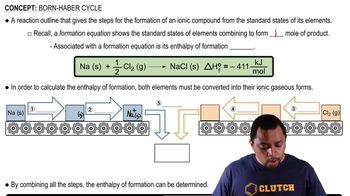
Born-Haber Cycle

The Born-Haber cycle is a thermodynamic cycle that relates the lattice energy of an ionic compound to other energy changes involved in its formation. It combines various enthalpy changes, such as sublimation, ionization, and electron affinity, to calculate the lattice energy, which is the energy released when gaseous ions form a solid ionic lattice.
Video consigliato:
Percorso guidato
03:49
Born Haber Cycle

Lattice Energy

Lattice energy is the amount of energy released when one mole of an ionic solid is formed from its gaseous ions. It is a measure of the strength of the forces between the ions in an ionic compound. Higher lattice energy indicates stronger ionic bonds, which typically results in higher melting points and greater stability of the compound.
Video consigliato:

Ionization Energy and Electron Affinity

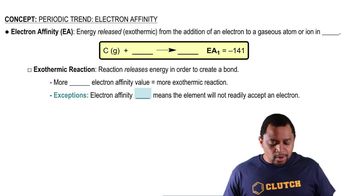
Ionization energy is the energy required to remove an electron from an atom or ion, while electron affinity is the energy change that occurs when an electron is added to a neutral atom. These concepts are crucial in the Born-Haber cycle as they help quantify the energy changes associated with the formation of cations and anions, which are essential for calculating lattice energy.
Video consigliato:
Percorso guidato
01:34
Electron Affinity