Ch.10 - Chemical Bonding I: The Lewis Model
Tro - Chemistry: A Molecular Approach 5th Edition
Tro5th EditionChemistry: A Molecular ApproachISBN: 9780134874371Non è quello che usi tu?Cambia libro di testo
Capitolo 10, Problema 40a,d

Write the Lewis symbols for the ions in each ionic compound. a. SrO d. RbF

Guida verificata passo dopo passo
1
Identify the elements involved in the compound RbF: Rubidium (Rb) and Fluorine (F).
Determine the electron configuration of each element: Rb is in Group 1 with one valence electron, and F is in Group 17 with seven valence electrons.
Understand that Rb will lose one electron to achieve a stable electron configuration, forming Rb⁺, and F will gain one electron to achieve a stable electron configuration, forming F⁻.
Draw the Lewis symbol for Rb⁺: Since Rb loses its one valence electron, its Lewis symbol is Rb with a positive charge, Rb⁺.
Draw the Lewis symbol for F⁻: Since F gains one electron, its Lewis symbol is F with eight dots around it and a negative charge, F⁻.

Risposta video verificata per un problema simile:

Questa soluzione video è stata consigliata dai nostri tutor come utile per risolvere questo problema.
Durata del video:
1m

Concetti chiave

Ecco i concetti essenziali che devi comprendere per rispondere correttamente alla domanda.

Lewis Symbols

Lewis symbols, or Lewis dot structures, represent the valence electrons of an atom as dots around the element's symbol. This notation helps visualize how atoms bond and interact in chemical compounds. For ions, the Lewis symbol indicates the loss or gain of electrons, reflecting their charged state.
Video consigliato:
Percorso guidato
00:52
Lewis Dot Symbols

Ionic Compounds

Ionic compounds are formed through the electrostatic attraction between positively charged ions (cations) and negatively charged ions (anions). In the case of RbF, rubidium (Rb) donates an electron to fluorine (F), resulting in Rb+ and F- ions. Understanding the formation of these ions is crucial for writing their Lewis symbols.
Video consigliato:
Percorso guidato
02:11
Ionic Compounds Naming

Charge of Ions

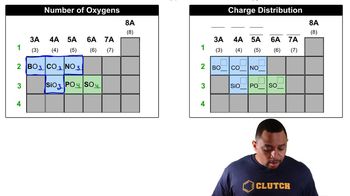
The charge of an ion is determined by the number of electrons lost or gained compared to the neutral atom. Cations, like Rb+, have a positive charge due to the loss of one electron, while anions, like F-, have a negative charge from gaining an electron. This charge is essential for accurately representing the ions in Lewis symbols.
Video consigliato:
Percorso guidato
01:39
Polyatomic Ion Charges