Ch.11 - Chemical Bonding II: Molecular Shapes, VSEPR & MO Theory
Tro - Chemistry: A Molecular Approach 5th Edition
Tro5th EditionChemistry: A Molecular ApproachISBN: 9780134874371Non è quello che usi tu?Cambia libro di testo
Capitolo 11, Problema 32

A molecule with the formula AB3 has a trigonal planar geometry. How many electron groups are on the central atom?

Guida verificata passo dopo passo
1
Identify the molecular geometry given in the problem, which is trigonal planar.
Recall that a trigonal planar geometry is associated with a central atom surrounded by three atoms in a plane, forming 120-degree bond angles.
Understand that the geometry is determined by the number of electron groups around the central atom, which include both bonding pairs and lone pairs of electrons.
Recognize that in a trigonal planar geometry, there are no lone pairs on the central atom, only bonding pairs.
Conclude that the number of electron groups on the central atom is equal to the number of atoms bonded to it, which is 3 in this case.

Risposta video verificata per un problema simile:

Questa soluzione video è stata consigliata dai nostri tutor come utile per risolvere questo problema.
Durata del video:
6m

Concetti chiave

Ecco i concetti essenziali che devi comprendere per rispondere correttamente alla domanda.

Molecular Geometry

Molecular geometry refers to the three-dimensional arrangement of atoms within a molecule. In the case of AB3, where A is the central atom and B represents the surrounding atoms, the trigonal planar geometry indicates that the three B atoms are arranged around A in a flat, triangular shape, with bond angles of approximately 120 degrees.
Video consigliato:
Percorso guidato
01:33
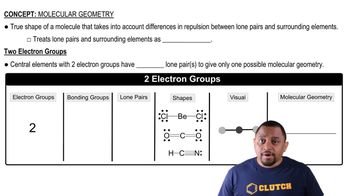
Molecular Geometry with Two Electron Groups

Electron Groups

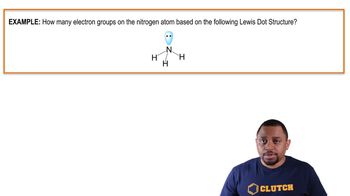
Electron groups include all regions of electron density around a central atom, which can be lone pairs, single bonds, double bonds, or triple bonds. In the context of the AB3 molecule, the central atom A has three bonding pairs of electrons associated with the three B atoms, leading to a total of three electron groups.
Video consigliato:
Percorso guidato
00:51
Electron Groups Example

VSEPR Theory

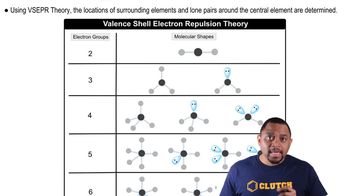
Valence Shell Electron Pair Repulsion (VSEPR) theory is a model used to predict the geometry of molecules based on the repulsion between electron pairs. According to VSEPR, electron groups will arrange themselves to minimize repulsion, which helps determine the molecular shape, such as the trigonal planar configuration observed in AB3.
Video consigliato:
Percorso guidato
02:13
Molecular Shapes and VSEPR