Ch.12 - Liquids, Solids & Intermolecular Forces
Tro - Chemistry: A Molecular Approach 5th Edition
Tro5th EditionChemistry: A Molecular ApproachISBN: 9780134874371Non è quello che usi tu?Cambia libro di testo
Capitolo 12, Problema 83

Explain the observed trend in the melting points of the hydrogen halides.
HI -50.8 °C
HBr -88.5 °C
HCl -114.8 °C
HF -83.1 °C

Guida verificata passo dopo passo
1
Identify the hydrogen halides in the problem: HI, HBr, HCl, and HF.
Observe the melting points provided: HI (-50.8 °C), HBr (-88.5 °C), HCl (-114.8 °C), and HF (-83.1 °C).
Note that HF has a higher melting point than HCl and HBr, despite being lighter, due to strong hydrogen bonding.
Recognize that the trend in melting points for HCl, HBr, and HI is influenced by molecular weight and van der Waals forces, with heavier molecules generally having higher melting points.
Conclude that the anomalously high melting point of HF is due to hydrogen bonding, which is stronger than the van der Waals forces affecting the other hydrogen halides.

Risposta video verificata per un problema simile:

Questa soluzione video è stata consigliata dai nostri tutor come utile per risolvere questo problema.

Concetti chiave

Ecco i concetti essenziali che devi comprendere per rispondere correttamente alla domanda.

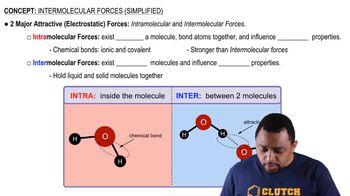
Intermolecular Forces

Intermolecular forces are the attractive forces between molecules that influence physical properties such as melting and boiling points. In hydrogen halides, these forces include hydrogen bonding, dipole-dipole interactions, and London dispersion forces. The strength and type of these forces vary among the hydrogen halides, affecting their melting points.
Video consigliato:
Percorso guidato
01:59
Intermolecular vs Intramolecular Forces

Hydrogen Bonding

Hydrogen bonding is a specific type of strong dipole-dipole interaction that occurs when hydrogen is bonded to highly electronegative atoms like fluorine, oxygen, or nitrogen. In the case of HF, the presence of hydrogen bonding significantly raises its melting point compared to other hydrogen halides, which primarily exhibit weaker dipole-dipole interactions.
Video consigliato:
Percorso guidato
01:22
Hydrogenation Reactions

Molecular Size and Mass

The size and mass of molecules influence their melting points due to the increase in London dispersion forces with larger molecular size. As we move from HF to HI, the molecular weight increases, which generally leads to higher melting points. However, the presence of hydrogen bonding in HF complicates this trend, resulting in its unique position among the hydrogen halides.
Video consigliato: