Ch.12 - Liquids, Solids & Intermolecular Forces
Tro - Chemistry: A Molecular Approach 5th Edition
Tro5th EditionChemistry: A Molecular ApproachISBN: 9780134874371Non è quello che usi tu?Cambia libro di testo
Capitolo 12, Problema 80

Water is a good solvent for many substances. What is the molecular basis for this property, and why is it significant?

Guida verificata passo dopo passo
1
Understand the molecular structure of water: Water (H2O) has a bent molecular shape with an angle of about 104.5 degrees between the hydrogen atoms. This shape leads to an uneven distribution of electron density, making water a polar molecule.
Recognize the importance of water's polarity: The polarity of water molecules allows them to form hydrogen bonds with other polar molecules and ions. This ability to form multiple hydrogen bonds makes water an effective solvent for many substances.
Explore the concept of 'like dissolves like': Polar solvents, such as water, are more effective at dissolving polar substances due to the interaction between polar molecules. This interaction involves the attraction between the positive and negative ends of the polar molecules.
Consider the significance of water's solvent properties: Water's ability to dissolve a wide range of substances is crucial for biological processes. For example, it allows for the transport of nutrients and waste products in living organisms and facilitates biochemical reactions.
Reflect on the environmental and chemical implications: The solvent properties of water also play a key role in environmental processes, such as the distribution of pollutants and the cycling of nutrients. In industrial and laboratory settings, water is used as a solvent in many chemical reactions and processes.

Risposta video verificata per un problema simile:

Questa soluzione video è stata consigliata dai nostri tutor come utile per risolvere questo problema.
Durata del video:
1m

Concetti chiave

Ecco i concetti essenziali che devi comprendere per rispondere correttamente alla domanda.

Polarity of Water

Water is a polar molecule, meaning it has a partial positive charge on one side (hydrogens) and a partial negative charge on the other (oxygen). This polarity allows water to interact with various ionic and polar substances, effectively surrounding and separating their molecules, which is essential for dissolving them.
Video consigliato:
Percorso guidato
02:38
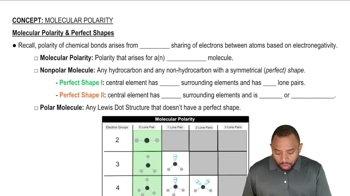
Molecular Polarity

Hydrogen Bonding

The polarity of water leads to hydrogen bonding, where the positive hydrogen atoms of one water molecule are attracted to the negative oxygen atoms of another. This strong intermolecular force contributes to water's high boiling point and its ability to dissolve many substances, making it an excellent solvent.
Video consigliato:
Percorso guidato
01:22
Hydrogenation Reactions

Solvation Process

Solvation is the process by which solvent molecules surround and interact with solute particles. In water, this involves the formation of hydration shells around ions or polar molecules, which stabilizes them in solution and facilitates chemical reactions, highlighting water's role in biological and chemical systems.
Video consigliato:
Percorso guidato
04:20
Spontaneity of Processes