Ch.12 - Liquids, Solids & Intermolecular Forces
Tro - Chemistry: A Molecular Approach 5th Edition
Tro5th EditionChemistry: A Molecular ApproachISBN: 9780134874371Non è quello che usi tu?Cambia libro di testo
Capitolo 12, Problema 51

Why does water in a glass tube with grease or oil residue display a flat meniscus, whereas water in a clean glass tube displays a concave meniscus?

Guida verificata passo dopo passo
1
Understand the concept of meniscus: A meniscus is the curve seen at the top of a liquid in response to its container. It can be concave or convex depending on the liquid and the container material.
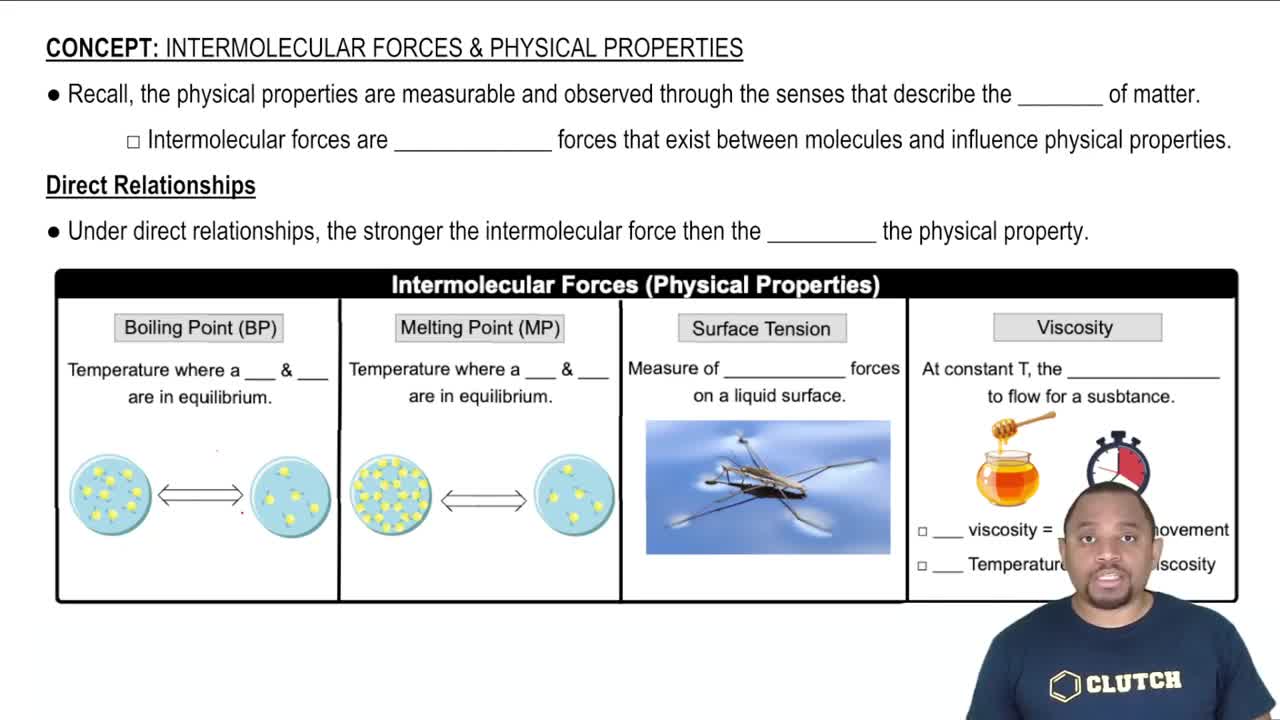
Identify the forces involved: The shape of the meniscus is determined by the balance between cohesive forces (attraction between like molecules) and adhesive forces (attraction between unlike molecules).
Consider water in a clean glass tube: Water has strong adhesive forces with glass, which are greater than its cohesive forces. This causes the water to climb up the sides of the glass, creating a concave meniscus.
Consider the effect of grease or oil: Grease or oil residue on the glass reduces the adhesive forces between the water and the glass. This diminishes the water's ability to climb the sides of the tube.
Explain the flat meniscus: With reduced adhesive forces due to the grease or oil, the cohesive forces within the water become more dominant, leading to a flatter meniscus compared to a clean glass tube.

Concetti chiave

Ecco i concetti essenziali che devi comprendere per rispondere correttamente alla domanda.

Meniscus Formation

A meniscus is the curve in the surface of a liquid in response to its container. It forms due to the balance between cohesive forces (attraction between liquid molecules) and adhesive forces (attraction between liquid molecules and the container). The shape of the meniscus can be concave or convex, depending on the relative strength of these forces.
Video consigliato:
Percorso guidato
02:34
Enthalpy of Formation

Cohesion and Adhesion

Cohesion refers to the intermolecular forces that hold similar molecules together, while adhesion describes the attraction between different substances. In the case of water, strong adhesive forces with clean glass lead to a concave meniscus, as water molecules are drawn up the sides of the tube. Conversely, grease or oil reduces adhesion, resulting in a flat meniscus due to the dominance of cohesive forces.
Video consigliato:
Percorso guidato
03:13
Intermolecular Forces and Properties

Surface Tension

Surface tension is the elastic tendency of a fluid surface that makes it acquire the least surface area possible. It arises from cohesive forces between liquid molecules at the surface. In a clean glass tube, water's high surface tension contributes to the formation of a concave meniscus, while the presence of grease or oil disrupts these cohesive interactions, leading to a flat meniscus.
Video consigliato:
Percorso guidato
03:13
Intermolecular Forces and Properties