For each compound, would you expect greater solubility in water or in hexane? Indicate the kinds of intermolecular forces that occur between the solute and the solvent in which the molecule is most soluble. a. glucose
Ch.14 - Solutions
Tro5th EditionChemistry: A Molecular ApproachISBN: 9780134874371Non è quello che usi tu?Cambia libro di testo
Capitolo 14, Problema 32
Which molecule would you expect to be more soluble in water: CCl4 or CH2Cl2?
Guida verificata passo dopo passo1
Identify the key property that affects solubility in water: polarity. Water is a polar solvent, so polar molecules are generally more soluble in water than nonpolar molecules.
Examine the molecular structure of CCl4 (carbon tetrachloride). It is a symmetrical molecule with four chlorine atoms bonded to a central carbon atom. This symmetry makes CCl4 a nonpolar molecule.
Examine the molecular structure of CH2Cl2 (dichloromethane). It has two hydrogen atoms and two chlorine atoms bonded to a central carbon atom. The presence of the more electronegative chlorine atoms creates a dipole moment, making CH2Cl2 a polar molecule.
Compare the polarity of the two molecules: CCl4 is nonpolar, while CH2Cl2 is polar. Since water is a polar solvent, it will better dissolve polar substances.
Conclude that CH2Cl2, being polar, is expected to be more soluble in water than CCl4, which is nonpolar.
Concetti chiave
Ecco i concetti essenziali che devi comprendere per rispondere correttamente alla domanda.
Polarity
Polarity refers to the distribution of electrical charge over the atoms in a molecule. Polar molecules have a significant difference in electronegativity between their atoms, leading to a dipole moment. This characteristic affects solubility, as polar substances tend to dissolve well in polar solvents like water, while nonpolar substances do not.
Video consigliato:
Percorso guidato
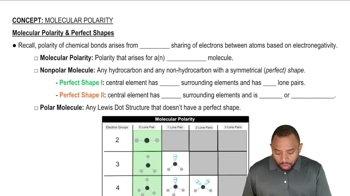
Molecular Polarity
Intermolecular Forces
Intermolecular forces are the forces of attraction or repulsion between neighboring particles (atoms, molecules, or ions). In the context of solubility, stronger intermolecular forces between solute and solvent molecules enhance solubility. Water, being a polar solvent, interacts favorably with polar solutes through hydrogen bonding and dipole-dipole interactions.
Video consigliato:
Percorso guidato
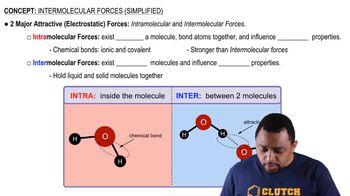
Intermolecular vs Intramolecular Forces
Like Dissolves Like
The principle of 'like dissolves like' states that polar solvents tend to dissolve polar solutes, while nonpolar solvents dissolve nonpolar solutes. This concept is crucial for predicting solubility; since water is polar, it will more readily dissolve polar molecules, such as CH2Cl2, compared to nonpolar molecules like CCl4.
Video consigliato:
Percorso guidato
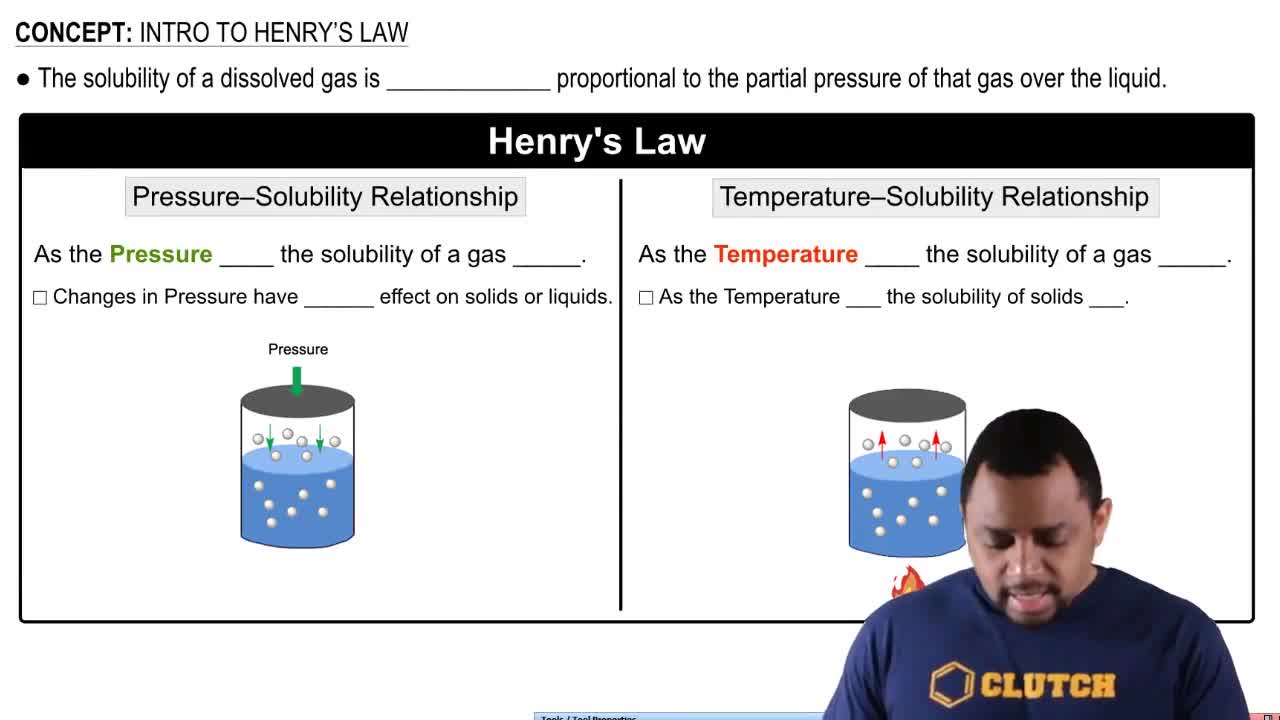
Henry's Law Solubility
Pratica correlata
Domanda del libro di testo
598
views
Domanda del libro di testo
When lithium iodide (LiI) is dissolved in water, the solution becomes hotter. a. Is the dissolution of lithium iodide endothermic or exothermic?
889
views
Domanda del libro di testo
For each compound, would you expect greater solubility in water or in hexane? Indicate the kinds of intermolecular forces that would occur between the solute and the solvent in which the molecule is most soluble. d. ethylene glycol
712
views
Domanda del libro di testo
Which molecule would you expect to be more soluble in water: CH3CH2CH2OH or HOCH2CH2CH2OH?
3972
views
Domanda del libro di testo
Pick an appropriate solvent from Table 13.3 to dissolve each substance. State the kind of intermolecular forces that would occur between the solute and solvent in each case. b. sodium chloride (ionic)
867
views
