Ch.16 - Chemical Equilibrium
Tro - Chemistry: A Molecular Approach 5th Edition
Tro5th EditionChemistry: A Molecular ApproachISBN: 9780134874371Non è quello che usi tu?Cambia libro di testo
Capitolo 16, Problema 51

Consider the reaction and the associated equilibrium constant: aA(g) ⇌ bB(g) Kc = 4.0 Find the equilibrium concentrations of A and B for each value of a and b. Assume that the initial concentration of A in each case is 1.0 M and that no B is present at the beginning of the reaction. c. a=1;b=2

Guida verificata passo dopo passo
1
Step 1: Write down the equilibrium expression for the reaction. For the reaction aA(g) ⇌ bB(g), the equilibrium constant expression is Kc = [B]^b / [A]^a. In this case, a=1 and b=2, so the expression becomes Kc = [B]^2 / [A].
Step 2: Set up an ICE (Initial, Change, Equilibrium) table to keep track of the changes in concentrations of A and B. Initially, [A] = 1.0 M and [B] = 0. At equilibrium, [A] = 1.0 - x and [B] = 2x, where x is the change in concentration of A that reacts.
Step 3: Substitute the equilibrium concentrations into the equilibrium expression. This gives 4.0 = (2x)^2 / (1.0 - x).
Step 4: Solve the resulting equation for x. This will give you the change in concentration of A and, since the stoichiometry of the reaction is 1:2, twice this value will be the equilibrium concentration of B.
Step 5: Substitute the value of x back into the expressions for the equilibrium concentrations of A and B to find their actual values at equilibrium.

Risposta video verificata per un problema simile:

Questa soluzione video è stata consigliata dai nostri tutor come utile per risolvere questo problema.

Concetti chiave

Ecco i concetti essenziali che devi comprendere per rispondere correttamente alla domanda.

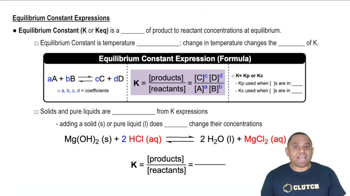
Equilibrium Constant (Kc)

The equilibrium constant, Kc, is a numerical value that expresses the ratio of the concentrations of products to reactants at equilibrium for a given reaction at a specific temperature. It is calculated using the formula Kc = [B]^b / [A]^a, where [B] and [A] are the equilibrium concentrations of the products and reactants, respectively. A Kc value greater than 1 indicates that products are favored at equilibrium.
Video consigliato:
Percorso guidato
03:20
Equilibrium Constant Expressions

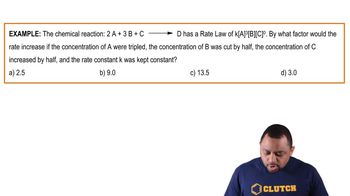
Initial Concentration and Changes at Equilibrium

In chemical reactions, the initial concentration of reactants and products influences the equilibrium position. For the reaction aA(g) ⇌ bB(g), if the initial concentration of A is 1.0 M and no B is present, the change in concentration as the system reaches equilibrium must be calculated. This involves determining how much A is converted to B based on the stoichiometric coefficients a and b.
Video consigliato:
Percorso guidato
02:10
Concentration Changes and Rate Law Example

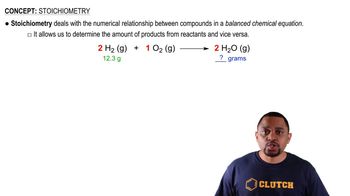
Stoichiometry in Reactions

Stoichiometry refers to the quantitative relationship between reactants and products in a chemical reaction, defined by their coefficients in the balanced equation. In the context of the given reaction, the coefficients a and b indicate the molar ratios in which A and B react and are produced. Understanding stoichiometry is essential for calculating the changes in concentrations of A and B as the system reaches equilibrium.
Video consigliato:
Percorso guidato
01:16
Stoichiometry Concept