
Consider the reaction: NH4HS(s) ⇌ NH3(g) + H2S(g) At a certain temperature, Kc = 8.5⨉10-3. A reaction mixture at this temperature containing solid NH4HS has [NH3] = 0.166 M and [H2S] = 0.166 M. Will more of the solid form or will some of the existing solid decompose as equilibrium is reached?
Ch.16 - Chemical Equilibrium
Tro5th EditionChemistry: A Molecular ApproachISBN: 9780134874371Non è quello che usi tu?Cambia libro di testo
Capitolo 16, Problema 49
Silver sulfate dissolves in water according to the reaction: Ag2SO4(s) ⇌ 2 Ag+(aq) + SO42-(aq) Kc = 1.1⨉10-5 at 298 K. A 1.5-L solution contains 6.55 g of dissolved silver sulfate. If additional solid silver sulfate is added to the solution, will it dissolve?
Guida verificata passo dopo passo1
Calculate the molar mass of silver sulfate (Ag2SO4) using the atomic masses of Ag, S, and O.
Determine the number of moles of silver sulfate in the solution by dividing the mass of silver sulfate (6.55 g) by its molar mass.
Calculate the initial concentration of silver sulfate in the solution by dividing the number of moles by the volume of the solution (1.5 L).
Use the stoichiometry of the dissolution reaction to find the equilibrium concentrations of Ag+ and SO4^2- ions in terms of the initial concentration of Ag2SO4.
Compare the reaction quotient (Q) with the equilibrium constant (Kc) to determine if additional solid silver sulfate will dissolve. If Q < Kc, more solid will dissolve; if Q > Kc, it will not.

Risposta video verificata per un problema simile:
Questa soluzione video è stata consigliata dai nostri tutor come utile per risolvere questo problema.
Durata del video:
4mConcetti chiave
Ecco i concetti essenziali che devi comprendere per rispondere correttamente alla domanda.
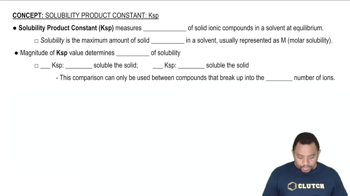
Solubility Product Constant (Ksp)
The solubility product constant (Ksp) is an equilibrium constant that applies to the solubility of sparingly soluble ionic compounds. It quantifies the extent to which a compound can dissolve in water, represented by the concentrations of its ions at equilibrium. For silver sulfate, Ksp = 1.1 x 10^-5 indicates that at 298 K, the product of the concentrations of Ag+ and SO4^2- ions in a saturated solution is equal to this value.
Video consigliato:
Percorso guidato
Solubility Product Constant
Le Chatelier's Principle
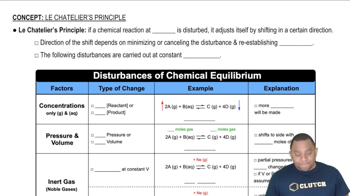
Le Chatelier's Principle states that if a system at equilibrium is disturbed, the system will adjust to counteract the disturbance and restore a new equilibrium. In the context of the silver sulfate dissolution, adding more solid Ag2SO4 increases the concentration of Ag+ and SO4^2- ions in the solution, which can shift the equilibrium position according to this principle, potentially affecting the solubility of the compound.
Video consigliato:
Percorso guidato
Le Chatelier's Principle
Saturation and Supersaturation
A solution is considered saturated when it contains the maximum concentration of solute that can dissolve at a given temperature. If additional solute is added to a saturated solution, it will not dissolve unless the solution becomes supersaturated, which occurs under specific conditions. In this case, understanding whether the current concentration of ions exceeds the Ksp value is crucial to determine if more silver sulfate can dissolve.
Video consigliato:
Percorso guidato
Saturated and Unsaturated Hydrocarbons
Pratica correlata
Domanda del libro di testo
3739
views
Domanda del libro di testo
Consider the reaction and the associated equilibrium constant: aA(g) ⇌ bB(g) Kc = 4.0 Find the equilibrium concentrations of A and B for each value of a and b. Assume that the initial concentration of A in each case is 1.0 M and that no B is present at the beginning of the reaction. c. a=1;b=2
2239
views
1
rank
Domanda del libro di testo
For the reaction shown here, Kc = 0.513 at 500 K. N2O4(g) ⇌ 2 NO2(g) If a reaction vessel initially contains an N2O4 concentration of 0.0500 M at 500 K, what are the equilibrium concentrations of N2O4 and NO2 at 500 K?
2036
views
1
comments
