A 100.0-mL buffer solution is 0.175 M in HClO and 0.150 M in NaClO. c. What is the pH after addition of 85.0 mg of NaOH?
Ch.18 - Aqueous Ionic Equilibrium
Tro5th EditionChemistry: A Molecular ApproachISBN: 9780134874371Non è quello che usi tu?Cambia libro di testo
Capitolo 18, Problema 51
A 350.0-mL buffer solution is 0.150 M in HF and 0.150 M in NaF. What mass of NaOH can this buffer neutralize before the pH rises above 4.00? If the same volume of the buffer were 0.350 M in HF and 0.350 M in NaF, what mass of NaOH could be handled before the pH rises above 4.00?
Guida verificata passo dopo passo1
Identify the components of the buffer solution: HF (weak acid) and NaF (its conjugate base).
Use the Henderson-Hasselbalch equation to find the pH of the buffer: \( \text{pH} = \text{pK}_a + \log \left( \frac{[\text{A}^-]}{[\text{HA}]} \right) \), where \( \text{pK}_a \) is the negative logarithm of the acid dissociation constant of HF.
Determine the amount of NaOH that can be added before the pH exceeds 4.00 by rearranging the Henderson-Hasselbalch equation to solve for the ratio \( \frac{[\text{A}^-]}{[\text{HA}]} \) when \( \text{pH} = 4.00 \).
Calculate the moles of HF and NaF initially present in the buffer using their concentrations and the volume of the solution.
For each buffer concentration scenario (0.150 M and 0.350 M), calculate the moles of NaOH that can be added by using the change in moles of HF and NaF required to reach the pH of 4.00, and convert this to mass using the molar mass of NaOH.
Concetti chiave
Ecco i concetti essenziali che devi comprendere per rispondere correttamente alla domanda.
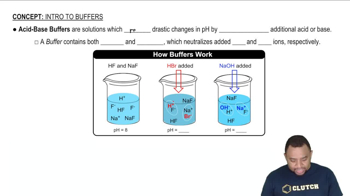
Buffer Solutions
A buffer solution is a system that resists changes in pH upon the addition of small amounts of acid or base. It typically consists of a weak acid and its conjugate base, which work together to neutralize added acids or bases. In this case, HF (a weak acid) and NaF (its conjugate base) form a buffer that can maintain a stable pH when NaOH (a strong base) is added.
Video consigliato:
Percorso guidato
Buffer Solutions
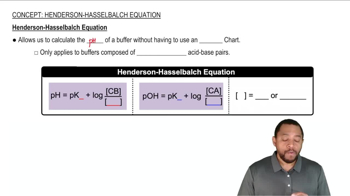
Henderson-Hasselbalch Equation
The Henderson-Hasselbalch equation relates the pH of a buffer solution to the concentration of its acid and conjugate base. It is expressed as pH = pKa + log([A-]/[HA]), where [A-] is the concentration of the conjugate base and [HA] is the concentration of the weak acid. This equation is essential for determining how much strong base can be added to a buffer before the pH exceeds a certain value, such as 4.00 in this question.
Video consigliato:
Percorso guidato
Henderson-Hasselbalch Equation
Neutralization Reaction
A neutralization reaction occurs when an acid reacts with a base to produce water and a salt, effectively reducing the pH of the solution. In the context of the buffer, adding NaOH will neutralize some of the HF, converting it to F-. The amount of NaOH that can be added before the pH rises above a specified level depends on the initial concentrations of HF and NaF, as well as the buffer capacity, which is determined by the amounts of the acid and base present.
Video consigliato:
Percorso guidato
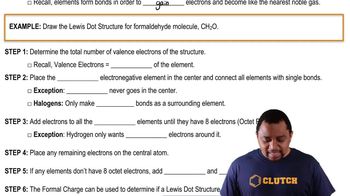
Lewis Dot Structures: Neutral Compounds
Pratica correlata
Domanda del libro di testo
900
views
Domanda del libro di testo
Determine whether or not the mixing of each pair of solutions results in a buffer. b. 50.0 mL of 0.10 M HCl; 35.0 mL of 0.150 M NaOH
472
views
Domanda del libro di testo
Determine whether or not the mixing of each pair of solutions results in a buffer. a. 100.0 mL of 0.10 M NH3; 100.0 mL of 0.15 M NH4Cl
637
views
Domanda del libro di testo
A 100.0-mL buffer solution is 0.100 M in NH3 and 0.125 M in NH4Br. What mass of HCl can this buffer neutralize before the pH falls below 9.00?
1290
views
1
comments
Domanda del libro di testo
For each solution, calculate the initial and final pH after adding 0.010 mol of NaOH. a. 250.0 mL of pure water b. 250.0 mL of a buffer solution that is 0.195 M in HCHO2 and 0.275 M in KCHO2 c. 250.0 mL of a buffer solution that is 0.255 M in CH3CH2NH2 and 0.235 M in CH3CH2NH3Cl
1490
views