
Domanda del libro di testo
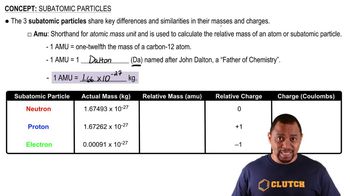
How many electrons are necessary to produce a charge of -1.0 C? What is the mass of this many electrons?
1766
views
2
rank
3
comments
 Guida verificata passo dopo passo
 05:19
05:19
 02:11
02:11 01:53
01:53How many electrons are necessary to produce a charge of -1.0 C? What is the mass of this many electrons?
Write isotopic symbols in the form X-A (e.g., C-13) for each isotope. a. the silver isotope with 60 neutrons
Which statements about subatomic particles are true? a. If an atom has an equal number of protons and electrons, it will be charge-neutral. b. Electrons are attracted to protons. c. Electrons are much lighter than neutrons. d. Protons have twice the mass of neutrons.
A helium nucleus has two protons and two neutrons. How many electrons does it take to equal the mass of a helium nucleus?
Write isotopic symbols in the form X-A (e.g., C-13) for each isotope. b. the silver isotope with 62 neutrons
Which statements about subatomic particles are false? a. Protons and electrons have charges of the same magnitude but opposite sign. b. Protons have about the same mass as neutrons. c. Some atoms don't have any protons. d. Protons and neutrons have charges of the same magnitude but opposite signs.