Ch.2 - Atoms & Elements
Tro - Chemistry: A Molecular Approach 5th Edition
Tro5th EditionChemistry: A Molecular ApproachISBN: 9780134874371Non è quello che usi tu?Cambia libro di testo
Capitolo 2, Problema 48

Which statements about subatomic particles are false? a. Protons and electrons have charges of the same magnitude but opposite sign. b. Protons have about the same mass as neutrons. c. Some atoms don't have any protons. d. Protons and neutrons have charges of the same magnitude but opposite signs.

Guida verificata passo dopo passo
1
Identify the charge of protons and electrons: Protons have a positive charge (+1) and electrons have a negative charge (-1). Their charges are equal in magnitude but opposite in sign.
Compare the masses of protons and neutrons: Protons and neutrons have similar masses, with neutrons being slightly heavier, but both are much heavier than electrons.
Consider the necessity of protons in atoms: All atoms must have at least one proton, as the number of protons defines the element and its atomic number.
Examine the charges of protons and neutrons: Protons have a positive charge, while neutrons are neutral and have no charge, so they do not have charges of the same magnitude or opposite signs.
Evaluate each statement based on the above analysis to determine which are false.

Risposta video verificata per un problema simile:

Questa soluzione video è stata consigliata dai nostri tutor come utile per risolvere questo problema.
Durata del video:
4m

Concetti chiave

Ecco i concetti essenziali che devi comprendere per rispondere correttamente alla domanda.

Subatomic Particles

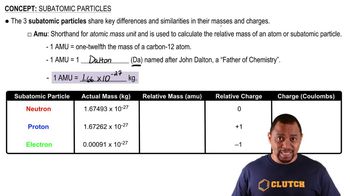
Subatomic particles are the fundamental constituents of atoms, primarily including protons, neutrons, and electrons. Protons are positively charged, neutrons are neutral, and electrons are negatively charged. Understanding the properties and charges of these particles is essential for analyzing atomic structure and chemical behavior.
Video consigliato:
Percorso guidato
05:19
Subatomic Particles

Charge of Particles

The charge of subatomic particles is a critical concept in chemistry. Protons carry a positive charge (+1), while electrons carry an equal but opposite negative charge (-1). Neutrons, on the other hand, have no charge. This charge balance is crucial for the stability of atoms and the formation of chemical bonds.
Video consigliato:
Percorso guidato
05:19
Subatomic Particles

Atomic Structure

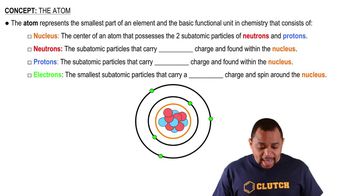
Atomic structure refers to the arrangement of subatomic particles within an atom. Atoms typically consist of a nucleus containing protons and neutrons, surrounded by electrons in various energy levels. The presence of protons defines the element, while the number of neutrons can vary, leading to different isotopes of the same element.
Video consigliato: