Ch.20 - Electrochemistry
Tro - Chemistry: A Molecular Approach 5th Edition
Tro5th EditionChemistry: A Molecular ApproachISBN: 9780134874371Non è quello che usi tu?Cambia libro di testo
Capitolo 20, Problema 116c

A rechargeable battery is constructed based on a concentration cell constructed of two Ag/Ag+ half-cells. The volume of each half-cell is 2.0 L, and the concentrations of Ag+ in the half-cells are 1.25 M and 1.0 × 10⁻³ M. c. Upon recharging, how long would it take to redissolve 1.00 × 10² g of silver at a charging current of 10.0 amps?

Guida verificata passo dopo passo
1
Calculate the number of moles of silver (Ag) that need to be redissolved using the formula: \( \text{moles of Ag} = \frac{\text{mass of Ag}}{\text{molar mass of Ag}} \). The molar mass of silver is approximately 107.87 g/mol.
Use Faraday's laws of electrolysis to relate the charge required to redissolve the silver. The formula is: \( Q = n \times F \), where \( Q \) is the total charge in coulombs, \( n \) is the number of moles of electrons, and \( F \) is Faraday's constant (approximately 96485 C/mol). Since each Ag atom requires one electron to be reduced, \( n \) is equal to the moles of Ag.
Determine the time required to supply this charge using the formula: \( t = \frac{Q}{I} \), where \( t \) is the time in seconds, \( Q \) is the charge in coulombs, and \( I \) is the current in amperes (10.0 A in this case).
Convert the time from seconds to a more convenient unit if necessary, such as minutes or hours, by using appropriate conversion factors.
Summarize the process: Calculate moles of Ag, determine the charge needed using Faraday's law, and then find the time required using the current provided.

Risposta video verificata per un problema simile:

Questa soluzione video è stata consigliata dai nostri tutor come utile per risolvere questo problema.
Durata del video:
5m

Concetti chiave

Ecco i concetti essenziali che devi comprendere per rispondere correttamente alla domanda.

Concentration Cells

A concentration cell is a type of electrochemical cell where two half-cells have different concentrations of the same ion. The cell generates an electromotive force (EMF) due to the difference in concentration, driving the spontaneous flow of electrons from the higher concentration to the lower concentration. This principle is crucial for understanding how rechargeable batteries operate, particularly in the context of redox reactions.
Video consigliato:
Percorso guidato
01:21
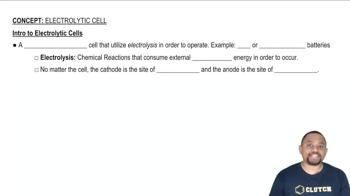
The Electrolytic Cell

Faraday's Law of Electrolysis

Faraday's Law states that the amount of substance transformed during electrolysis is directly proportional to the quantity of electric charge passed through the cell. This law allows us to calculate the mass of a substance, such as silver, that can be deposited or dissolved during the charging process, using the formula: mass = (current × time × molar mass) / (n × F), where n is the number of moles of electrons transferred and F is Faraday's constant.
Video consigliato:
Percorso guidato
01:40
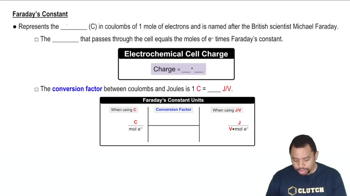
Faraday's Constant in Electrochemistry

Current and Time Relationship

The relationship between current, time, and charge is fundamental in electrochemistry. Current (measured in amperes) is defined as the flow of electric charge per unit time. To determine how long it takes to dissolve a specific mass of silver, one must relate the total charge required (calculated from the mass of silver) to the current applied, using the formula: time = total charge / current.
Video consigliato:
Percorso guidato
02:16
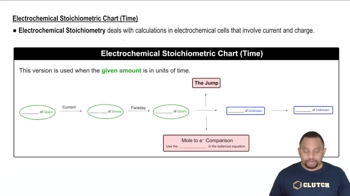
Electrochemical Stoichiometric Chart (Time)