Ch.20 - Electrochemistry
Tro - Chemistry: A Molecular Approach 5th Edition
Tro5th EditionChemistry: A Molecular ApproachISBN: 9780134874371Non è quello che usi tu?Cambia libro di testo
Capitolo 20, Problema 116a

A rechargeable battery is constructed based on a concentration cell constructed of two Ag/Ag+ half-cells. The volume of each half-cell is 2.0 L, and the concentrations of Ag+ in the half-cells are 1.25 M and 1.0×10⁻³ M. a. How long can this battery deliver 2.5 Aof current before it goes dead?

Guida verificata passo dopo passo
1
Identify the half-reactions for the concentration cell. In a concentration cell, the same species is involved in both half-reactions, but at different concentrations. Here, the half-reaction is Ag+ + e- → Ag for both electrodes.
Calculate the cell potential (Ecell) using the Nernst equation: Ecell = E°cell - (RT/nF) * ln(Q), where E°cell is 0 for a concentration cell, R is the gas constant (8.314 J/mol·K), T is the temperature in Kelvin, n is the number of moles of electrons transferred (1 for Ag/Ag+), F is Faraday's constant (96485 C/mol), and Q is the reaction quotient, which is the ratio of the concentrations of Ag+ in the two half-cells.
Substitute the given concentrations into the Nernst equation. The reaction quotient Q is [Ag+]anode/[Ag+]cathode = 1.0×10^-3 M / 1.25 M.
Determine the total charge (Q) that can be delivered by the battery using the formula Q = n * F, where n is the number of moles of electrons transferred. Since the current (I) is given as 2.5 A, use the relationship Q = I * t to find the time (t) the battery can deliver this current.
Solve for time (t) using the equation t = Q/I, where Q is the total charge calculated in the previous step and I is the current (2.5 A). This will give you the duration for which the battery can deliver the specified current before it goes dead.

Risposta video verificata per un problema simile:

Questa soluzione video è stata consigliata dai nostri tutor come utile per risolvere questo problema.
Durata del video:
4m

Concetti chiave

Ecco i concetti essenziali che devi comprendere per rispondere correttamente alla domanda.

Concentration Cells

A concentration cell is a type of electrochemical cell where the electrodes are the same material but are immersed in solutions of different concentrations. The potential difference arises from the difference in concentration of ions, driving the flow of electrons from the higher concentration to the lower concentration. This principle is crucial for understanding how the battery operates and generates electrical energy.
Video consigliato:
Percorso guidato
01:21
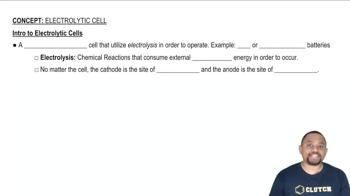
The Electrolytic Cell

Nernst Equation

The Nernst equation relates the cell potential to the concentrations of the reactants and products in an electrochemical reaction. It allows for the calculation of the electromotive force (EMF) of the cell based on the concentration of ions. This equation is essential for determining how the varying concentrations of Ag<sup>+</sup> in the half-cells affect the overall voltage and performance of the battery.
Video consigliato:
Percorso guidato
01:17
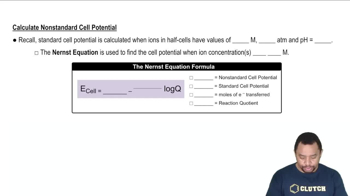
The Nernst Equation

Current and Time Relationship

The relationship between current, charge, and time is described by the equation Q = I × t, where Q is the total charge, I is the current, and t is the time. This concept is vital for calculating how long the battery can deliver a specific current before depleting its charge. Understanding this relationship helps in determining the operational duration of the battery based on its capacity and the current draw.
Video consigliato:
Percorso guidato
02:16
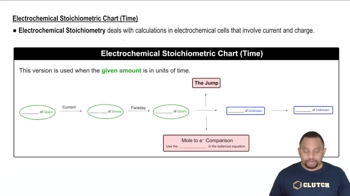
Electrochemical Stoichiometric Chart (Time)
Pratica correlata
Domanda del libro di testo

A rechargeable battery is constructed based on a concentration cell constructed of two Ag/Ag+ half-cells. The volume of each half-cell is 2.0 L, and the concentrations of Ag+ in the half-cells are 1.25 M and 1.0 × 10⁻³ M. b. What mass of silver is plated onto the cathode by running at 3.5 A for 5.5 h?

427
views
Domanda del libro di testo

A battery relies on the oxidation of magnesium and the reduction of Cu2+. The initial concentrations of Mg2+ and Cu2+ are 1.0 × 10⁻⁴ M and 1.5 M, respectively, in 1.0-liter half-cells. b. What is the voltage of the battery after delivering 5.0 A for 8.0 h?

414
views
1
rank
Domanda del libro di testo

A battery relies on the oxidation of magnesium and the reduction of Cu2+. The initial concentrations of Mg2+ and Cu2+ are 1.0 × 10⁻⁴ M and 1.5 M, respectively, in 1.0-liter half-cells. a. What is the initial voltage of the battery?

1435
views
Domanda del libro di testo

A battery relies on the oxidation of magnesium and the reduction of Cu2+. The initial concentrations of Mg2+ and Cu2+ are 1.0 × 10⁻⁴ M and 1.5 M, respectively, in 1.0-liter half-cells. c. How long can the battery deliver 5.0 A before going dead?

799
views
1
rank
1
comments
Domanda del libro di testo

A rechargeable battery is constructed based on a concentration cell constructed of two Ag/Ag+ half-cells. The volume of each half-cell is 2.0 L, and the concentrations of Ag+ in the half-cells are 1.25 M and 1.0 × 10⁻³ M. c. Upon recharging, how long would it take to redissolve 1.00 × 10² g of silver at a charging current of 10.0 amps?

657
views